What Makes a Fishing Line Supplier Suitable for Private Label?
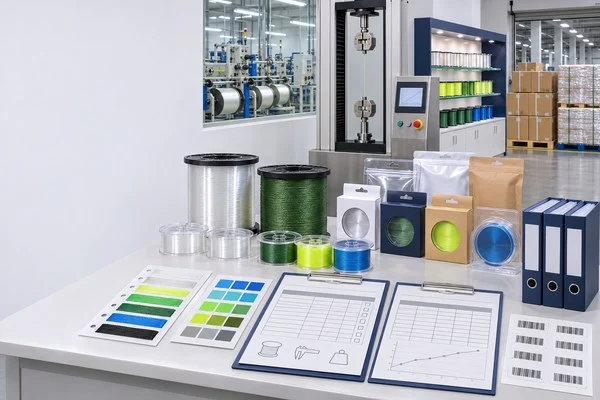
Choosing the right fishing line supplier for private label production is critical for ensuring both product performance and successful market entry[^1]. The supplier must manage everything — from fishing line specifications to packaging and regulatory details — with precision. This article explores the key factors that define a truly suitable private-label supplier for fishing lines.
A suitable fishing line supplier for private label projects demonstrates competency in product customization, packaging development, and traceability of every production decision. Beyond exceptional fishing line performance, they must ensure consistent labeling, meet regulatory requirements, and offer measurable specification control.
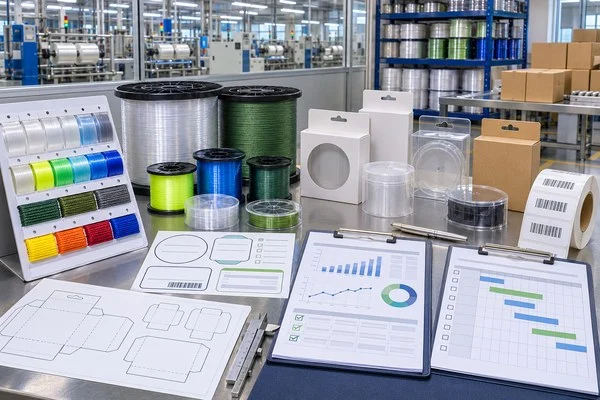
Managing the complexities of private-label fishing lines involves more than just producing a good product. From packaging design to compliance, effective communication, and measurable specifications, a supplier’s ability to deliver on all fronts determines their suitability.
Why is traceability critical for private-label projects?
Traceability ensures production consistency and market reliability[^2], reducing risks associated with product variations[^3].
Traceability allows every approved sample to be linked back to its raw materials, production methods, artwork, and testing records. This ensures that what gets produced matches the customer’s specification every time, enabling reliable quality control[^4].

Ignoring traceability can lead to inconsistent batches, causing unexpected product failures, misaligned labeling, or quality degradation. For private-label products, these issues can tarnish brand reputation[^5]. Proper traceability involves:
- Raw material tracking (e.g., nylon or PE inputs).
- Documentation of the production process and techniques (e.g., strand count for braided lines).
- Maintaining artwork records for labels and packaging.
- Testing results verified against product benchmarks.
Traceability builds confidence, especially during repeat orders or supplier transitions. If you cannot trace back a product’s development path, you risk introducing errors when scaling production.
Checklist for Traceability:
- Raw Material Identification: Ensure suppliers document the material source and grade.
- Process Recordkeeping: Confirm manufacturing settings (e.g., extrusion temperatures or braiding tension).
- Testing Logs: Request tensile strength, knot performance, and abrasion resistance data.
- Artworks and Label Version: All labels must match current regulatory and branding requirements.
- Batch Traceability: Samples and production batches should align with testing outcomes.
Mistakes arise when samples approved during development fail to match the final mass production — particularly if raw materials or assembly techniques change without communication.
How should suppliers translate market demand into measurable fishing line specs?
A qualified supplier bridges the gap between abstract market goals and technical specifications.
Suppliers convert target market needs into measurable characteristics[^6] such as line diameter, tensile strength, handling performance, and packaging details. Additionally, they must balance trade-offs like cost, minimum order quantities (MOQs), and line performance.

Market requirements can vary based on fishing methods, geography, or competitive trends. Customers targeting saltwater anglers may prioritize abrasion resistance and knot strength[^7], while freshwater brands may emphasize flexibility and casting ease. The supplier must evaluate these target scenarios against technical compromises, including:
- Diameter Variations: Thinner diameters often improve casting but may reduce durability.
- Breaking Strength Trade-offs: Higher tensile strength may lead to increased costs.
- Line Memory: Smooth handling versus performance under stretching conditions.
- MOQ Requirements: Small private-label projects may require flexible MOQ thresholds.
By consulting on these trade-offs with the customer, suppliers avoid mismatching the fishing line specification to its intended audience.
Key Metrics to Balance:
- Target Line Performance: Specifications for handling, visibility, and application-specific adaptability.
- Cost versus Performance: Raw material grades dictate both the price and longevity of the line.
- MOQ Flexibility: First-time private-label purchases often start with smaller trials.
- Ease of Evaluation: Suppliers should explain how their fishing lines fit practical needs using tangible testing results.
This collaborative approach avoids generic or unsuitable stock options, tailoring production to the business strategy behind the private label.
Why is disciplined sample evaluation more important than speed?
Rushed sampling can undermine private-label testing accuracy and confidence.
Discipline in sample evaluation ensures every prototype reflects genuine production realism[^8]. A rushed sample process overlooks the correlation between raw materials, visual details, artwork, and real-world performance.

Private-label buyers often focus on reaching approval quickly to progress the timeline. However, skipping critical verification steps can lead to problems like:
- Packaging errors — labels, pole winders, or barcodes missing or inconsistent.
- Incorrect breaking strength or size when transitioning from sample to mass production.
- Artwork divergence because the supplier reused outdated designs.
Disciplined sampling means that every test sample becomes a reference point for all manufacturing decisions. Samples need rigorous tests in areas like tensile performance, knot strength, spool handling, uniform coloring, and abrasion resistance.
Practical Sampling Guidelines:
- Approve Only Fully Traceable Samples: Ensure every sample has production trace logs.
- Verify Artworks Separately: Packaging designs and labels must align with local market compliance.
- Test End-Application Strength: Simulate real-world fishing conditions in testing labs.
- Confirm Spool Specifications: Length, winding quality, and balance must match packaging needs.
While speed may seem attractive, it compromises thorough evaluation and risks costly revisions in later production stages.
What makes a supplier essential for export and compliance?
More than just manufacturing fishing lines, private-label suppliers must ensure smooth exports and compliance.
Suitable suppliers offer support for destination-specific requirements including barcodes, external packaging, country-of-origin labels, and export documents. This makes them an essential partner in avoiding regulation-based delays.

A supplier unfamiliar with export compliance risks failing to meet labeling standards or mismanaging documentation like commercial invoices or packing declarations. Successful export preparation involves:
- Barcodes and Labeling: Match market requirements, e.g., GS1 standards for retail chains.
- Shipping Cartons: Optimize bulk packaging layouts for wholesalers or distributors.
- Country-of-Origin Indicators: Legal compliance often mandates visible COO markings.
- Document Accuracy: Properly detailed certificates streamline customs clearance.
A refined export setup helps private-label brands focus on marketing without delays caused by logistics mismanagement.
Export Prep Essentials:
- Printing & Labeling: Confirm SKU codes and packaging artwork dimensions.
- Regulatory Labels: Use destination-specific product origin tags and compliance symbols.
- Certificate Setup: Organize customs documentation alongside packing specs.
- Carton Design: Suitable dimensions to minimize shipping waste or maximize pallet stacking.
Proper export alignment also reduces disputes at the retailer level if barcodes or labeling visual mismatches occur.
Can a trial order reveal supplier suitability?
Small trial orders can expose supplier’s communication and problem-solving capabilities[^9].
Sending a small quantity trial order is often the best way to evaluate how suppliers respond to queries, manage production changes, and correct unavoidable errors. It provides more insight than relying solely on price estimates.
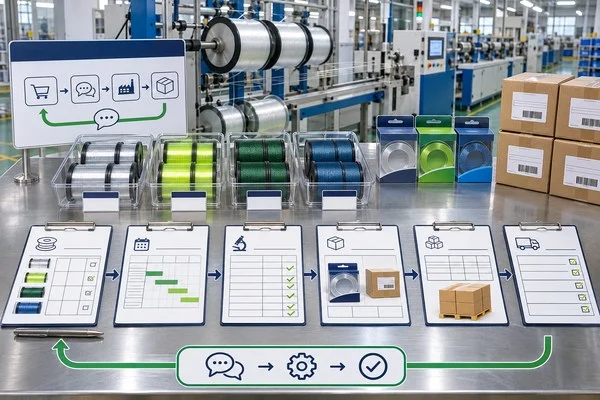
During trial orders, pay attention to supplier responses. Are they punctual? Do they explain decision paths when problems arise? Can they maintain composure while resolving details like diameter corrections or artwork alignment? These traits matter far more for private-label success than flashy upfront quotations.
Trial Evaluation Tip:
- Response Time: Are emails and questions replied to quickly or delayed repeatedly?
- Correction Management: How professionally do they handle artwork or spool winding instructions?
- Problem Ownership: Suppliers should solve underlying causes instead of shifting blame.
- Flexibility During Pain Points: Transparency about MOQ adjustments or unexpected graphical errors.
Trial runs expose whether your supplier can maintain reliability over the lifetime of the private-label relationship.
Frequently Asked Questions
What packaging options should private-label suppliers offer?
Reliable private-label suppliers offer custom spool dimensions, retail-ready packaging, bulk shipping options, and label designs compatible with target sales channels like e-commerce or store shelves.
What fishing line properties are critical for market success?
Breaking strength, abrasion resistance, knot performance, line diameter, and memory-free handling are key metrics. Suppliers should offer measurable testing for these[^10].
Why is detailed artwork approval necessary?
Confirmed artwork avoids outdated graphics, mismatched barcodes, or missing regulatory marks[^11]. It’s essential for all retail-forward sales channels.
How can suppliers help with customs clearance?
Suppliers provide COO labels, certificates of origin, commercial invoices, and accurate packing declarations[^12] for smooth inspections.
What MOQ flexibility should private-label suppliers provide?
First-time projects often require lower MOQ thresholds. Suppliers willing to adapt show reliability during early private-label trial runs.
Conclusion
A suitable fishing line supplier for private-label production stands out by offering traceability, measurable specs, and compliance support while balancing performance, cost, and MOQ requests. Private-label projects require more than a great product; they require a partner capable of managing every detail — from samples to export certainties.
If you're ready to explore private-label fishing line solutions, let’s talk. Together, we’ll develop products tailored to your market success.
[^1]: "Supplier Selection and Assessment: Their Impact on Business ...", https://digitalcommons.usu.edu/manage_facpub/271/. Research indicates that supplier selection plays a critical role in ensuring product quality and successful market entry, as suppliers influence both production standards and compliance with market requirements. Evidence role: general_support; source type: research. Supports: The importance of selecting the right supplier for private label production to ensure product performance and market success.. Scope note: The source may not specifically address fishing line suppliers but provides general insights into private label production. [^2]: "Importance of Traceability in Manufacturing", https://telesis.com/importance-of-traceability-in-manufacturing/. Studies show that traceability systems in manufacturing help maintain product consistency and reduce risks by enabling detailed tracking of materials and processes. Evidence role: mechanism; source type: research. Supports: The role of traceability in ensuring production consistency and reducing risks in manufacturing.. Scope note: The source may discuss traceability in general manufacturing rather than specifically in fishing line production. [^3]: "Traceability Plans for Food Products", https://extension.msstate.edu/publications/traceability-plans-for-food-products. Research highlights that traceability systems mitigate risks of product variations by ensuring consistent adherence to production specifications and quality standards. Evidence role: general_support; source type: research. Supports: How traceability reduces risks associated with product variations in manufacturing.. Scope note: The evidence may not be specific to fishing line production but applies broadly to manufacturing industries. [^4]: "Traceability is quality control - Cajo Technologies", https://cajotechnologies.com/blog_news/traceability-is-quality-control/. Studies confirm that traceability systems enhance quality control by linking production records to customer specifications, ensuring consistency in manufacturing. Evidence role: mechanism; source type: research. Supports: The role of traceability in linking production records to ensure reliable quality control.. Scope note: The source may not specifically address fishing line production but discusses general manufacturing practices. [^5]: "market-failure-in-the-supply-of-traceability-industry-and- ...", https://www.ers.usda.gov/media/13320/market-failure-in-the-supply-of-traceability-industry-and-government-response.pdf?v=69629. Case studies in manufacturing demonstrate that traceability failures can result in product inconsistencies, leading to customer dissatisfaction and harm to brand reputation. Evidence role: case_reference; source type: research. Supports: How traceability failures can lead to product inconsistencies and damage brand reputation.. Scope note: The evidence may not focus exclusively on private-label fishing lines but is relevant to private-label manufacturing in general. [^6]: "EFFECTIVE METHODOLOGIES FOR SUPPLIER SELECTION ...", https://etda.libraries.psu.edu/files/final_submissions/419. Research on supplier roles in product development shows that they often translate market demands into technical specifications to meet customer requirements. Evidence role: mechanism; source type: research. Supports: The process by which suppliers translate market needs into measurable product specifications.. Scope note: The source may not specifically address fishing line suppliers but discusses general supplier practices. [^7]: "Freshwater Lines versus Saltwater Lines", https://scientificanglers.com/freshwater-fly-lines-versus-saltwater-fly-lines/. Studies on fishing line performance indicate that saltwater anglers often prioritize abrasion resistance and knot strength, while freshwater anglers value flexibility and casting ease. Evidence role: general_support; source type: research. Supports: Differences in fishing line preferences for saltwater and freshwater applications.. Scope note: The evidence may not cover all fishing scenarios but provides general insights into angler preferences. [^8]: "The management of good manufacturing practice (GMP ... - PMC", https://pmc.ncbi.nlm.nih.gov/articles/PMC12645793/. Research highlights that disciplined sample evaluation is critical for ensuring that prototypes accurately represent final production quality. Evidence role: mechanism; source type: research. Supports: The importance of disciplined sample evaluation in ensuring production realism.. Scope note: The source may not specifically address fishing line production but discusses general manufacturing practices. [^9]: "Evaluation", https://en.wikipedia.org/wiki/Evaluation. Research on supplier evaluation methods suggests that small trial orders are effective in assessing communication, responsiveness, and problem-solving skills. Evidence role: general_support; source type: research. Supports: The role of small trial orders in evaluating supplier communication and problem-solving capabilities.. Scope note: The evidence may not specifically address fishing line suppliers but discusses general supplier evaluation practices. [^10]: "fishing line tests", https://www.uakron.edu/polymer/agpa-k12outreach/lesson-plans/fishing-line-tests. Studies on quality assurance in manufacturing emphasize the need for measurable testing to validate product performance and compliance with specifications. Evidence role: general_support; source type: research. Supports: The importance of measurable testing in ensuring product quality and performance.. Scope note: The evidence may not focus exclusively on fishing line production but is relevant to manufacturing quality assurance. [^11]: "Workarounds to Barcode Medication Administration Systems", https://pmc.ncbi.nlm.nih.gov/articles/PMC2442264/. Studies on product labeling emphasize that confirmed artwork ensures compliance with regulatory standards and prevents errors such as mismatched barcodes or outdated graphics. Evidence role: general_support; source type: research. Supports: How confirmed artwork prevents issues like outdated graphics, mismatched barcodes, and missing regulatory marks.. Scope note: The evidence may not focus exclusively on fishing line packaging but is relevant to product labeling in general. [^12]: "Common Export Documents", https://www.trade.gov/common-export-documents. Government export guidelines highlight the necessity of COO labels, certificates of origin, and accurate commercial invoices for compliance with international trade regulations. Evidence role: general_support; source type: government. Supports: The importance of COO labels, certificates of origin, and commercial invoices in ensuring smooth customs inspections.. Scope note: The source may not specifically address fishing line exports but applies to general export practices.