Fishing Line Quality Control: What Should a Buyer Test Before Shipment?
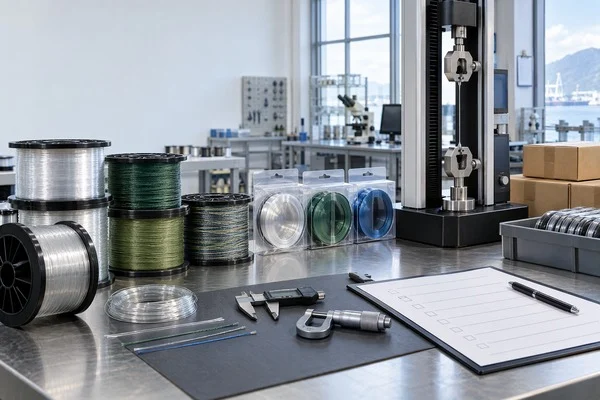
Ensuring consistent quality in fishing line products requires verification well beyond simple visual checks. Fishing line quality control[^1] is crucial to avoid issues like customer complaints, product returns, or costly disruptions in the supply chain. Buyers must meticulously check both performance metrics and the physical specifications of the product before shipment.
Before shipment, buyers should test fishing line performance parameters such as breaking strength, knot strength, and abrasion resistance[^2], along with packaging details like spool quality, labeling, and carton markings. Random sampling from multiple production batches ensures unbiased quality verification.[^3]
Even if the product looks correct, hidden inconsistencies can lead to serious failures when customers begin to use it. Let’s dive deeper into the quality control process — from sampling to testing and documentation — to see how buyers can certify fishing lines before release.
Why define test specifications beforehand?
Rushed inspections can lead to errors.
Test specifications should always be defined in advance[^4], rather than improvising acceptance rules after production ends. Inspections with unclear guidelines risk overlooking critical parameters or introducing subjective flaws into the evaluation.
Clear specifications give buyers and suppliers agreed-upon criteria for quality control tests. Buyers should verify these specifications match their purchase order before conducting any checks.
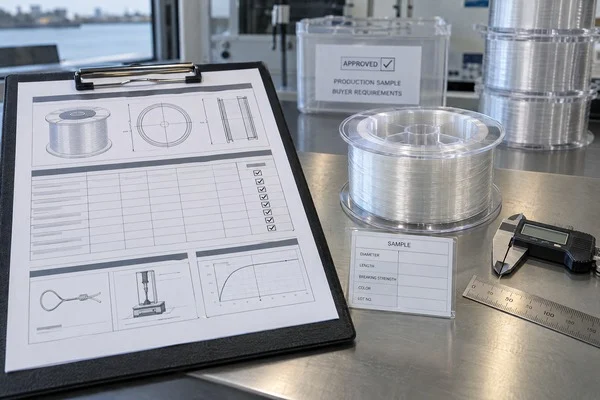
Consistency starts with communication. At Qiaohui Industrial Monofilament Co., Ltd., buyers work closely with us to verify that production aligns with the agreed specifications. This prevents last-minute disputes over what "acceptable quality" really means.
Key takeaway: Define approved specifications in writing before production begins. This document should outline all performance, dimensional, and packaging requirements.
How can sampling methods reduce inspection bias?
Sampling represents the entire batch.
To avoid biased results, inspect randomly selected samples from different cartons, equipment, or production batches. Never rely solely on factory-prepared presentation samples, as these may not represent the wider shipment.
Random sampling ensures that average quality, not exceptional examples, determines pass/fail decisions.[^5] This is critical for large shipments where variability between production batches can occur.
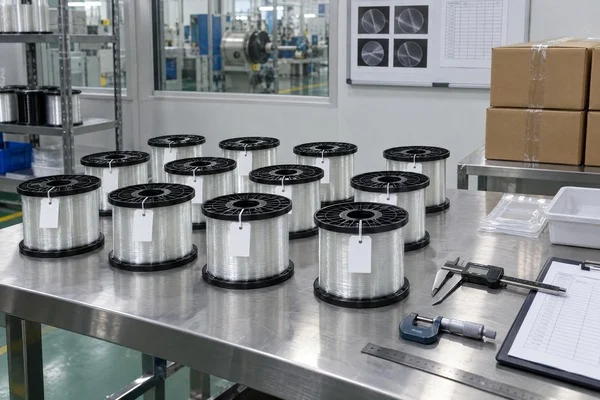
Here at our factory, we always recommend buyers request random samples to avoid discrepancies between pre-shipment inspections and final delivery. This process can involve selecting spools from various cartons or serial numbers spread across production lots.
Key takeaway: Random sampling prevents bias and provides a more accurate snapshot of batch quality.
What performance metrics absolutely must be tested?
Performance metrics determine real-world reliability.
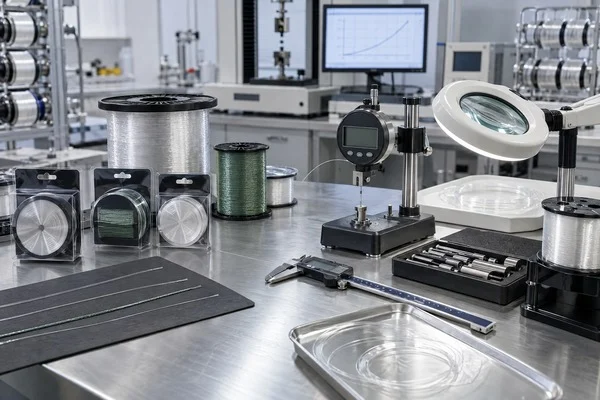
Critical performance factors such as breaking strength, knot strength, and abrasion resistance must always be tested using agreed methods and calibrated equipment.[^6] Results should match the buyer-approved specification to eliminate surprises during end-user applications.
Performance testing should only use equipment still within valid calibration dates.[^7] Outdated machinery can distort results, causing errors in pass/fail decisions.
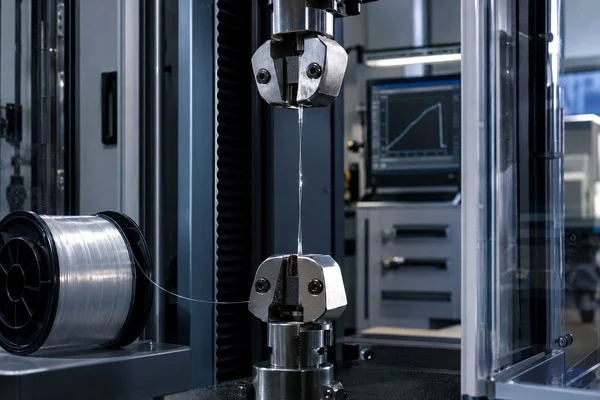
At Qiaohui Industrial, we trust lab-grade tensile testers calibrated to industry standards. Buyers verify a fishing line’s break strength at tension points, knot durability under pull-strain, and resistance against abrasive conditions. These tests simulate real fishing demands — ensuring product reliability matches the promised specifications.
Key takeaway: Test critical performance factors, and always confirm testing machines are properly calibrated.
What package and labeling details require inspection?
Physical details prevent logistical errors.
Buyers should always inspect spool winding, line length, spool condition, labels, barcodes, packing quantities, and carton identification marks.[^8] Even if the line’s performance meets requirements, poor packaging or mislabeling can create serious disruptions across sales channels.
Packaging checks typically include:
- Verification of line spool winding quality
- Exact meter length or spool weight
- Accurate labeling/barcode placement
- Damage-free spools or packaging
- Correct carton marking and inventory counting
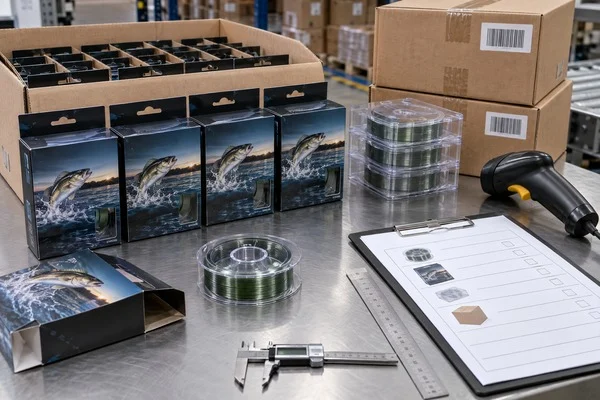
At Qiaohui Industrial, every spool undergoes winding and meter-length checks before shipment. Buyers also inspect printed labels to confirm key data for retail readiness. Inaccurate cartons or barcodes can disrupt wholesaler logistics, raising costs for distribution.
Key takeaway: Packaging specifications are just as important as product performance. Verify these details before approving shipment.
How should defects be classified during inspection?
A standardized process enables objective decisions.
Define defect tolerances and release rules before inspection begins.[^9] This ensures inspection reports directly inform pass/fail shipment decisions, rather than leaving room for vague interpretation.
Common defect classifications include:
- Critical defects: Impact functional use (e.g., line breaks).
- Major defects: Affect appearance/value (e.g., incorrect spool color).
- Minor defects: Are purely cosmetic but permissible.
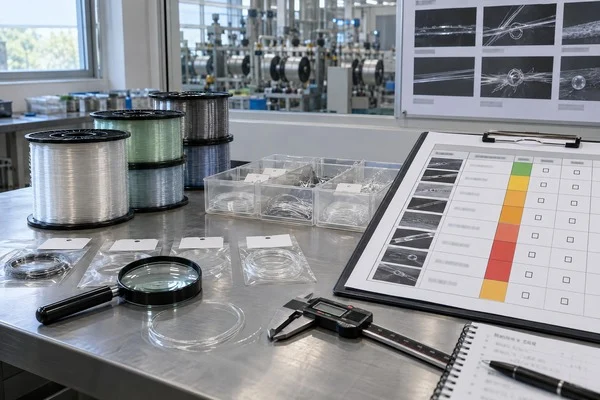
Inspection standards at Qiaohui Industrial guide buyers in applying tolerances both to fishing line performance and packaging details. Clear guidelines reduce delays and streamline the release process.
Key takeaway: Defined tolerances ensure inspection reports directly support shipment approvals.
Frequently Asked Questions
Why shouldn’t factory-issued samples be trusted?
Factory-issued samples often highlight ideal outcomes from production.[^10] Random sampling from actual shipments provides buyers a truer reflection of overall quality. Trusting pre-prepared samples risks approving inconsistent batches.
How often should testing equipment be calibrated?
Testing equipment should be calibrated regularly, typically every 6 months or according to the manufacturer’s guidelines.[^11] Ensuring calibration validity protects inspection accuracy.
Can packaging discrepancies justify rejecting a shipment?
Packaging errors — like incorrect spool length or damaged cartons — can disrupt logistics and retail presentation. Buyers may delay shipment release or request corrections depending on severity.
What happens if performance metrics fail during inspection?
When performance tests fail, the batch must be rechecked against the approved specification. If results still deviate, buyers might reject the shipment or negotiate corrective measures.
Should buyers oversee inspections onsite?
Directly overseeing onsite inspections allows buyers to verify supplier procedures and ensure consistency with their specifications. This reduces dependency on third-party assessment alone.
Conclusion
Quality control for fishing lines ensures product reliability, logistical efficiency, and satisfied end-users. Before shipment, buyers must test fishing line performance (breaking strength, knot strength, abrasion resistance), physical details (spool winding, labels, carton markings), and packaging consistency to confirm specifications are met.
At Qiaohui Industrial Monofilament Co., Ltd., we ensure every step in the inspection process aligns with the buyer’s requirements. Clear test specifications, unbiased sampling, calibrated testing methods, and standardized defect tolerances help eliminate risks before shipment release.
Interested in verifying your fishing line specifications? Contact us today for testing and quality control support tailored to your needs. Ensure reliability before your product hits the market!
[^1]: "What Causes Anglers to Leave Behind Less Fishing Line and ...", https://ncseagrant.ncsu.edu/hooklinescience/what-causes-anglers-to-leave-behind-less-fishing-line-and-other-litter/. Research studies have shown that inadequate quality control in fishing line production can lead to customer dissatisfaction, increased product returns, and logistical inefficiencies, particularly in industries reliant on consistent product performance. Evidence role: general_support; source type: research. Supports: The importance of quality control in fishing line manufacturing to prevent customer complaints, product returns, and supply chain disruptions.. Scope note: The source may provide general insights into quality control but may not focus exclusively on fishing lines. [^2]: "Comparing Measured Fluorocarbon Leader Breaking Strength with ...", https://ui.adsabs.harvard.edu/abs/arXiv:1202.5260. Studies in material science and fishing gear performance highlight breaking strength, knot strength, and abrasion resistance as key indicators of fishing line reliability and durability. Evidence role: general_support; source type: research. Supports: The necessity of testing breaking strength, knot strength, and abrasion resistance as critical performance metrics for fishing lines.. Scope note: The source may discuss these metrics in general terms and not specifically in the context of pre-shipment testing. [^3]: "Sampling Methodologies | Comptroller's Handbook", https://www.occ.gov/publications-and-resources/publications/comptrollers-handbook/files/sampling-methodologies/pub-ch-sampling-methodologies.pdf. Educational resources on quality control emphasize that random sampling reduces bias and provides a representative assessment of production quality. Evidence role: general_support; source type: education. Supports: The role of random sampling in ensuring unbiased quality verification in manufacturing processes.. Scope note: The source may discuss random sampling broadly and not specifically for fishing line manufacturing. [^4]: "46 CFR § 164.019-13 - Production quality control requirements.", https://www.law.cornell.edu/cfr/text/46/164.019-13. Institutional guidelines on quality management, such as ISO standards, recommend pre-defining test specifications to avoid subjective evaluations and ensure consistent quality assessments. Evidence role: expert_consensus; source type: institution. Supports: The necessity of defining test specifications in advance to ensure consistent and objective quality control.. Scope note: The source may provide general quality control guidelines and not specific examples from the fishing line industry. [^5]: "Selecting a Sampling Design", https://www.epa.gov/quality/selecting-sampling-design. Research on quality control methods demonstrates that random sampling is a statistically valid approach to assess the average quality of production batches and avoid bias. Evidence role: general_support; source type: research. Supports: The effectiveness of random sampling in ensuring that average quality is assessed in quality control processes.. Scope note: The source may not specifically address fishing line manufacturing. [^6]: "fishing line tests", https://www.uakron.edu/polymer/agpa-k12outreach/lesson-plans/fishing-line-tests. Educational materials on quality assurance highlight that calibrated equipment is essential for obtaining reliable and reproducible test results in performance evaluations. Evidence role: mechanism; source type: education. Supports: The importance of using calibrated equipment to ensure accurate testing of critical performance factors like breaking strength and abrasion resistance.. Scope note: The source may discuss calibration broadly and not specifically for fishing line testing. [^7]: "Resources: Calibration Procedures", https://www.nist.gov/pml/owm/laboratory-metrology/documentary-standards-and-resources/calibration-procedures. Institutional guidelines on quality assurance emphasize that using calibrated equipment is critical for ensuring the accuracy and reliability of test results. Evidence role: expert_consensus; source type: institution. Supports: The requirement to use calibrated equipment for accurate performance testing in quality control.. Scope note: The source may provide general calibration guidelines and not specific examples for fishing line testing. [^8]: "A Guide to Traceability within the Fish Industry", https://seafood.oregonstate.edu/sites/agscid7/files/snic/guide-to-traceability-within-the-fishery-industry.pdf. Educational resources on packaging quality control highlight the need to verify physical and labeling details to prevent logistical errors and ensure retail readiness. Evidence role: general_support; source type: education. Supports: The importance of inspecting packaging details such as spool winding, line length, and labeling to ensure product quality and logistical efficiency.. Scope note: The source may discuss packaging quality control broadly and not specifically for fishing lines. [^9]: "News: The Importance of Quality Control in Engineering ...", https://www.automate.org/news/the-importance-of-quality-control-in-engineering-and-manufacturing. Institutional quality control standards recommend pre-defining defect tolerances to ensure objective and consistent inspection outcomes. Evidence role: expert_consensus; source type: institution. Supports: The necessity of defining defect tolerances and release rules before conducting inspections.. Scope note: The source may provide general guidelines and not specific examples from the fishing line industry. [^10]: "Selecting a Sampling Design", https://www.epa.gov/quality/selecting-sampling-design. Studies on quality control practices indicate that factory-prepared samples are often selected to showcase the best outcomes, which may not reflect the average quality of production batches. Evidence role: general_support; source type: research. Supports: The tendency of factory-issued samples to represent ideal outcomes rather than average production quality.. Scope note: The source may discuss this issue broadly and not specifically for fishing line manufacturing. [^11]: "Recommended Calibration Interval", https://www.nist.gov/calibrations/recommended-calibration-interval. Institutional guidelines on equipment calibration suggest regular intervals, such as every 6 months, to maintain accuracy and reliability in quality testing. Evidence role: expert_consensus; source type: institution. Supports: The recommendation to calibrate testing equipment regularly, typically every 6 months or as per manufacturer guidelines.. Scope note: The source may provide general calibration recommendations and not specific examples for fishing line testing equipment.