
What Information Should You Send a Fishing Line Manufacturer for an Accurate Quote?
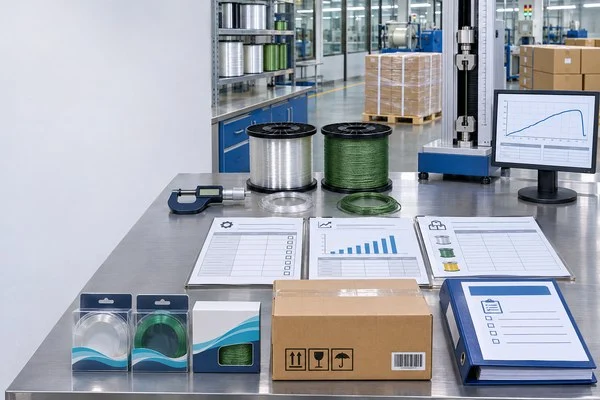
Obtaining an accurate quote from a fishing line manufacturer starts with supplying the right information. Many buyers mistakenly believe that sending a single photo or just specifying the pound-test is enough. But manufacturing quotes rely on detailed product specifications, packaging requirements, order volumes, and delivery details[^1]. Let’s break down what you need to share.
To get an accurate quote from a fishing line manufacturer, supply comprehensive details about the line’s specifications, packaging, order quantity, and delivery terms all within one document. Include precise data such as material, construction, diameter, breaking strength, application, and expected order patterns to avoid confusion and hidden costs.

Sending piecemeal information can lead to unreliable pricing and delays in production planning. Below, I’ll guide you through every detail you should include to streamline the quoting process and ensure clarity for both you and the manufacturer.
Why do fishing line specifications matter for accurate quotes?
The wrong specifications can lead to unnecessary product discrepancies[^2].
Fishing line specifications are critical because they define the exact materials, performance targets, and production requirements. If the specs are vague or incomplete, the manufacturer cannot calculate costs accurately or guarantee reliable production.
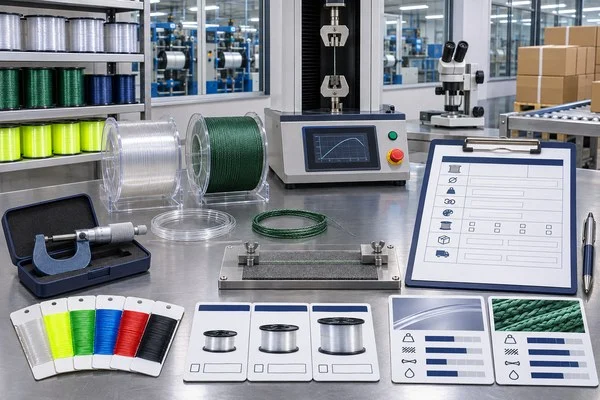
When sending your request for quotation (RFQ), define the following specifications clearly:
- Line type and material: Nylon monofilament, PE braided, fluorocarbon, etc.
- Construction style: Single-strand, multi-strand, or braided thread, including specific strand counts.
- Target diameter: Specify measured line diameter, not just standard categories.
- Breaking strength: Include details of testing methods, such as straight-line tensile strength or knot strength.
- Length: Define spool length options like 50m, 100m, or bulk configurations.
- Color and coatings: Highlight color requirements, UV resistance, or surface finishes.
- Application details: Target fishing method (e.g., saltwater, freshwater, or competition).
What packaging information should you include?
Packaging can significantly impact costs — often unexpectedly[^4].
Provide detailed packaging specifications like spool design, labeling, box dimensions, and artwork responsibilities to help the manufacturer calculate MOQ (Minimum Order Quantity) costs accurately.
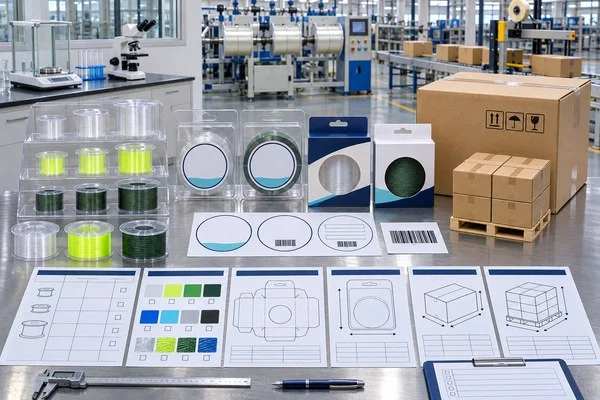
Packaging decisions affect both production setup cost and logistics. Include these details in your RFQ:
- Spool structure: Diameter, material, labeling position, and weight tolerance.
- Labels and barcodes: Placement, printing requirements, and format compatibility for retail systems.
- Outer packaging: Box design, specialized inserts, protective layers, and branding requirements for e-commerce or retail sales.
- Artwork responsibilities: Specify whether you will supply print-ready designs or need the manufacturer’s help to finalize documents.
- Shipping requirements: Define bulk configurations (e.g., master cartons or pallets).
Why is the order quantity format important?
Exact quantities affect pricing structure[^6].
Break down order quantities by SKU to prevent logistical confusion during quoting. Include initial batch volumes and your expected reorder frequency to help the manufacturer predict production economics.
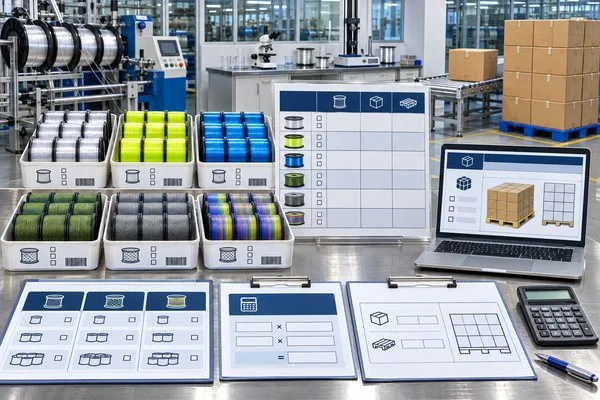
Instead of vague yearly projections, specify:
- First order quantities: Provide exact numbers for each SKU (e.g., “1000 transparent nylon monofilament spools of 100m length”).
- Reorder plans: Describe how future orders are likely to follow. Will replenishment happen monthly, quarterly, or seasonally?
- Small SKU orders: Keep in mind that splitting orders into small quantities across various SKUs can raise production setup costs.
Speaking from experience, this part often gets overlooked. Buyers send estimates like "10,000 spools yearly," but manufacturers need detailed, broken-down figures for feasibility assessments.
Why are delivery terms critical in the quoting process?
Delivery impacts both pricing and logistics assumptions[^7].
Supply clear destination details, trade terms, and shipping deadlines to let the manufacturer separate product costs from freight costs when calculating your quotes.
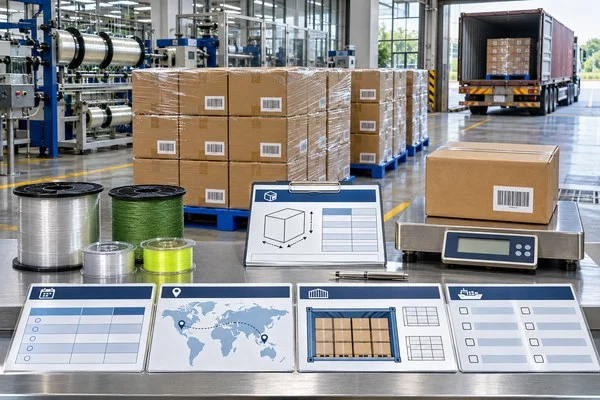
Include the following delivery information:
- Destination port: Specify where the goods will be shipped (e.g., “Port of Los Angeles”).
- Trade terms: State whether quotes should follow EXW (Ex Works), FOB (Free On Board), or CIF (Cost, Insurance, and Freight).
- Customs documents: Provide clarity on certifications, packing lists, or labeling needed to meet import regulations.
- Inspection requirements: If third-party inspection is required, mention the exact procedure or agency.
- Target delivery date: Share your production timeline to assess factory capacity alignment.
This information helps manufacturers avoid assumptions and ensures logistics estimations match your needs.
What to include in the RFQ overview document?
Combine all essential information into one organized file.
A professional RFQ should centralize fishing line specifications, packaging details, volumes, delivery terms, and artwork responsibilities into a single document. This simplifies communication and minimizes quoting errors.
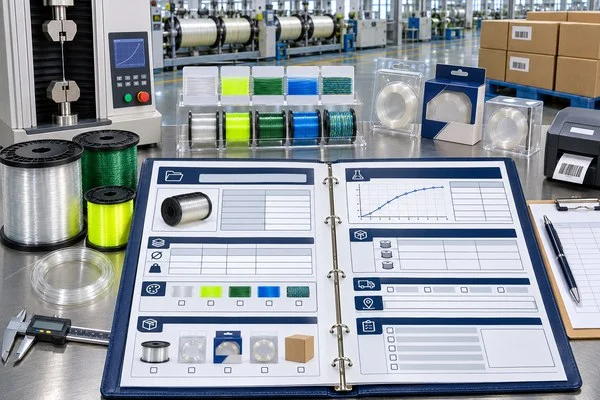
Here’s how I suggest structuring your RFQ overview:
| Section | What to Include |
|---|---|
| Fishing Line Specs | Material, construction, line diameter, breaking strength, length, color, coatings, application. |
| Packaging Details | Spool dimensions, labels, cartons, barcodes, artwork roles, retail/e-commerce considerations. |
| Order Quantities | SKU-specific first order volumes and projected reorders (broken down per configuration). |
| Delivery Information | Destination port, trade terms, delivery deadlines, and inspection criteria. |
Remember, sending fragmented emails or missing major details can delay quotes and complicate negotiations. Be thorough.
Frequently Asked Questions
Should MOQ change based on packaging details?
Yes, packaging often dictates MOQ. Complex designs, specialized spool materials, or branded boxes may increase setup costs, requiring higher minimum order volumes to offset production expenses[^8].
Can diameters or strength ratings affect raw material costs?
Absolutely. Tight tolerances, unusual line sizes, or extreme strength ratings require more precise processes and higher-grade materials, impacting the unit cost[^9].
Should the RFQ document mention barcodes or label formats?
Yes, always share barcode specifications and label formats upfront. This prevents production delays or labeling errors that could make your fishing lines unusable for retail systems.
Conclusion
Providing comprehensive information is critical to receiving an accurate quote from a fishing line manufacturer. Specifications like material, diameter, breaking strength, packaging designs, order quantities, and delivery terms should all be included upfront in a centralized RFQ document[^10]. This helps the manufacturer deliver accurate pricing, forecast production feasibility, and align logistics with your business needs[^11].
Want to take the guesswork out of your next fishing line project? Contact us to discuss your specifications and ensure your product reaches the market with confidence.
[^1]: "Manufacturing Quotation in 2025 - Challenges and ...", https://caddi.com/en-us/resources/insights/manufacturing-quotation-in-2025/. Detailed RFQs are essential for manufacturers to calculate accurate quotes, as they provide necessary information on specifications, packaging, and order volumes. This is a common practice in manufacturing industries. Evidence role: general_support; source type: education. Supports: Manufacturing quotes depend on detailed product specifications, packaging requirements, order volumes, and delivery details.. [^2]: "A systematic review of decision tools for process selection and ...", https://pmc.ncbi.nlm.nih.gov/articles/PMC12592300/. Research indicates that incomplete or incorrect specifications can lead to production errors, material mismatches, and quality issues in manufacturing. Evidence role: general_support; source type: research. Supports: Incorrect specifications can result in product discrepancies.. [^3]: "What Does Data Analytics for Manufacturing Entail?", https://tsengcollege.csun.edu/blog/what-does-data-analytics-for-manufacturing-entail. Studies show that detailed RFQs allow manufacturers to streamline material procurement, adjust machinery settings accurately, and optimize production workflows. Evidence role: mechanism; source type: research. Supports: Providing detailed data helps manufacturers optimize material sourcing, machinery adjustments, and process flows.. [^4]: "Environmental Impact of Food Packaging Materials - PMC - NIH", https://pmc.ncbi.nlm.nih.gov/articles/PMC7664184/. Research highlights that packaging design, materials, and customization can significantly influence production and logistics costs in manufacturing. Evidence role: general_support; source type: research. Supports: Packaging decisions can have a significant and sometimes unexpected impact on costs.. [^5]: "The Impact of Visual Elements of Packaging Design on ... - PMC", https://pmc.ncbi.nlm.nih.gov/articles/PMC11851823/. Studies indicate that vague packaging specifications can result in miscommunication, leading to inaccurate cost estimates and delivery issues. Evidence role: general_support; source type: research. Supports: Unclear packaging details can lead to inaccurate quotes or unmet expectations.. [^6]: "Economic order quantity", https://en.wikipedia.org/wiki/Economic_order_quantity. Manufacturing studies show that order quantities directly affect pricing due to economies of scale and production setup costs. Evidence role: mechanism; source type: research. Supports: Exact order quantities influence the pricing structure in manufacturing.. [^7]: "Improving On-Time Delivery Rates in Manufacturing by ...", https://scholarworks.wmich.edu/cgi/viewcontent.cgi?article=4884&context=honors_theses. Studies show that delivery terms, including destination and trade terms, significantly affect both cost calculations and logistics planning in manufacturing. Evidence role: mechanism; source type: research. Supports: Delivery details influence both pricing and logistics assumptions in manufacturing.. [^8]: "Inferences from Visual Complexity in Package Design", https://bear.warrington.ufl.edu/sela/ryu_affonso_sela_2025_design_complexity.pdf. Research shows that specialized packaging requirements often lead to higher setup costs, which manufacturers offset by increasing minimum order quantities. Evidence role: mechanism; source type: research. Supports: Complex designs, specialized spool materials, or branded boxes can increase setup costs, necessitating higher minimum order volumes.. [^9]: "Unit Cost Handbook.htm", https://nps.edu/documents/103424423/106950814/Unit+Cost+Handbook-web.pdf/7ceabbcb-d102-4b2e-9678-61ff47a39f00. Studies show that tighter tolerances and specialized material requirements increase production complexity and costs in manufacturing. Evidence role: mechanism; source type: research. Supports: Tight tolerances, unusual line sizes, or extreme strength ratings increase unit costs due to the need for precise processes and higher-grade materials.. [^10]: "Understanding the Request for Quotation (RFQ) Process in ...", https://lassosupplychain.com/resources/blog/request-for-quotation-rfq-process-in-manufacturing/. Educational resources on procurement emphasize that a comprehensive RFQ document should include detailed specifications, packaging, and delivery terms to ensure accurate quotes. Evidence role: general_support; source type: education. Supports: Including specifications like material, diameter, breaking strength, packaging designs, order quantities, and delivery terms in a centralized RFQ document is essential for accurate quotes.. [^11]: "RFQ manufacturing: What is it and how to optimize it?", https://www.neuralconcept.com/post/rfq-manufacturing-what-is-it-and-how-to-optimize-it. Research indicates that detailed RFQs enable manufacturers to provide precise cost estimates, plan production schedules, and coordinate logistics effectively. Evidence role: general_support; source type: research. Supports: Providing comprehensive RFQ information helps manufacturers deliver accurate pricing, forecast production feasibility, and align logistics with business needs..