Nylon Monofilament Extrusion Process: Technical Manufacturing Guide
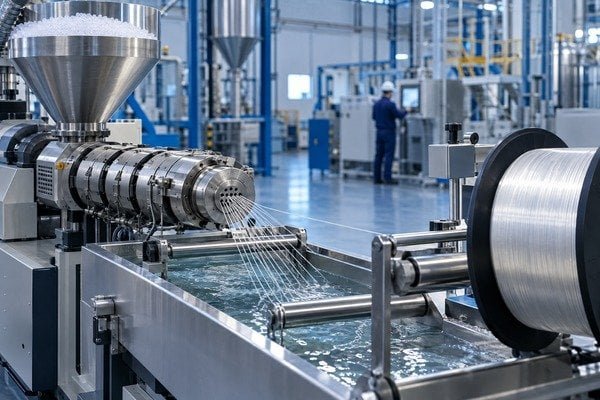
Understanding the nylon monofilament extrusion process is crucial for manufacturers and buyers alike.[^1] This process determines not just the shape of the filament but also its strength, elongation, memory, and diameter consistency. When evaluating nylon fishing lines or industrial monofilament products, understanding how extrusion and drawing steps influence performance can help differentiate quality manufacturers.
The nylon monofilament extrusion process involves precise control over resin properties, moisture content, drawing ratios, cooling, and stabilization. Each stage impacts key characteristics like breaking strength, shrinkage, and memory retention.[^2] Ensuring stable conditions and verifying batch consistency are essential for high-quality production.

The extrusion of nylon monofilament is far from simple. Beyond choosing the right resin grade, buyers and engineers must consider how melt conditions, drawing ratios, cooling, and post-processing affect product quality. Let’s break down the process and explore how each step contributes to performance.
How does resin choice affect nylon monofilament extrusion?
Choosing the right resin is only the starting point for nylon monofilament production.
The resin grade defines the base material's potential, but extrusion and drawing conditions determine the monofilament's final properties such as diameter, strength, elongation, and memory. Variables like water content and melt stability play critical roles.

Different nylon resin grades offer varying levels of tensile strength, elongation, and durability. However, without precise melt control during extrusion, issues such as bubbles, crystal points, and diameter variance may arise. Effective manufacturers monitor moisture levels, stabilize melt conditions, and adjust parameters based on each resin grade and target filament diameter.
Resin selection tips:
- Nylon 6 provides a balance between flexibility and strength, making it ideal for fishing applications.
- Nylon 66 offers higher tensile performance but requires more careful processing to minimize brittleness.[^3]
- Resin moisture levels below 0.2% can significantly reduce extrusion defects like air bubbles and crystallinity changes.[^4]
Quality resin alone cannot guarantee performance — extrusion conditions and stretching ratios ultimately form the filament's properties.
What role does moisture control play in extrusion?
Moisture content directly impacts the extrusion quality and long-term performance of nylon monofilament.
Low moisture levels minimize bubbles and crystalline defects, leading to smoother extrusion. Stabilizing melt conditions further reduces line diameter fluctuations caused by inconsistent resin feed characteristics. Both factors must align with target specifications for optimal results.

Water absorption in nylon can cause degradation during melting, leading to bubbles that weaken tensile strength and create surface irregularities.[^5] Manufacturers combat this by thoroughly drying nylon resin before extrusion. Online melt monitoring systems are also crucial for maintaining consistent diameter and preventing batch variations.
For buyers evaluating suppliers, questions to ask include:
- Does the manufacturer measure resin moisture before extrusion?
- What melt stabilization systems are in place to control feed uniformity?
- Are diameter fluctuations tracked across multiple production batches?
Proper moisture control eliminates many risks that affect filament dimensions and downstream performance.
Why is drawing important in nylon monofilament manufacturing?
Drawing ratios improve the filament's strength by aligning molecular chains. However, excessive or uneven stretching can lead to increased brittleness and batch variance. Carefully controlled drawing multiplies breaking strength while maintaining flexibility and durability.

During stretching, long-chain molecules in the nylon resin orient themselves along the filament axis. This increases tensile strength and reduces elongation under load. While higher drawing ratios offer greater strength potential, over-stretching can compromise durability by introducing brittleness. Variance between production rolls may also arise from unstable drawing conditions.
Factors affecting drawing quality:
- Stretching temperature and speed — Rapid, inconsistent movement increases variance.
- Drawing ratios — Balancing strength with flexibility prevents product defects.
- Tension monitoring — Uniform tension ensures consistent properties across rolls.
Quality suppliers use automated systems to monitor and adjust drawing conditions dynamically. These systems mitigate risks from poorly executed stretching, enabling batch consistency for demanding applications like fishing lines.
How does cooling and stabilization influence performance?
Cooling and thermal setting control shrinkage, memory, and size stability in nylon monofilament.[^7]
Well-controlled cooling reduces residual stresses, improves spool winding quality, and maintains post-processing stability. Improper stabilization can cause dimensional variance, memory retention issues, and performance defects in end-use applications like fishing.[^8]

Cooling stages allow the extruded monofilament to solidify, while thermal stabilization further “locks” molecular structures into place. Cooling speed, water bath temperature, and heat-setting conditions can affect shrinkage, diameter accuracy, and spool handling characteristics.
Customers should request post-conditioning tests that simulate final product storage and usage environments. Specifications based on freshly extruded samples may not reflect actual performance once humidity and reel conditions influence memory retention.
Buyer evaluation checklist:
- Does the supplier verify shrinkage after moisture conditioning tests?
- Are reel samples tested for memory and handling before shipment?
- How consistent is diameter across extruded and packaged rolls?
Cooling and stabilization are critical stages that can make or break filament performance, particularly in moisture-sensitive applications.
How is quality control performed in nylon monofilament extrusion?
Quality control systems and testing protocols ensure optimized and consistent nylon monofilament production.
Effective quality control involves real-time diameter measurement, stretch monitoring, and periodic batch sampling.[^9] End-product tensile testing alone cannot detect risks introduced earlier in the extrusion process. Comprehensive evaluation methods reduce defects and batch inconsistencies.

High-quality manufacturers employ automated diameter measurement at every stage of extrusion and drawing. This minimizes batch-level defects and identifies where process improvements may eliminate inconsistencies.
Critical QC practices include:
- Real-time diameter measurement: Inline monitoring spots deviations and informs adjustments.
- Drawing record maintenance: Parameters tracked for product variance reduction.
- Periodic sampling: Roll inspection ensures consistent metrics between batches.
- Process management: Established protocols for changing resin grades or filament profiles.
Buyers evaluating manufacturers should seek transparency in quality control documentation.[^10] Asking for parameter records and comparative test results reduces risks tied to unverified production processes.
Frequently Asked Questions
How does nylon monofilament extrusion differ from other polymers?
Unlike polypropylene or polyester, nylon requires greater moisture control and molecular orientation during extrusion due to its hygroscopic nature.[^11] Nylon monofilament typically undergoes higher draw ratios to achieve strength and flexibility balance.
What is the significance of shrinkage testing?
Shrinkage testing simulates how nylon filaments will react to post-extrusion exposure to moisture and temperature changes.[^12] This ensures the filament retains stable dimensions after winding, storage, and handling.
Can tensile tests assure overall filament quality?
No. While tensile tests verify breaking strength, diameter fluctuation, crystallinity defects, and memory retention require broader evaluation methods such as inline monitoring, shrinkage tests, and comparative batch sampling.
Conclusion
The nylon monofilament extrusion process combines resin selection, moisture control, molecular orientation through stretching, cooling, and stabilization to achieve critical filament properties. Manufacturers investing in robust quality control reduce common production risks such as diameter inconsistencies and brittleness. As buyers, we should prioritize suppliers who offer transparent production data and evaluate batch-level consistency.
If you're sourcing nylon monofilament for fishing or industrial applications, contact us to learn about our technical manufacturing expertise and quality-control processes. We have helped brands, distributors, and OEMs develop customized solutions that meet performance requirements with confidence.
[^1]: "Nylon Monofilament Extrusion Machine : Everything You ...", https://www.plasco.com.tw/en/article/Nylon_Monofilament_Extrusion_Machines.html. Research studies on polymer extrusion processes highlight how precise control over extrusion parameters directly influences product quality and market competitiveness. Evidence role: general_support; source type: research. Supports: The significance of understanding the nylon monofilament extrusion process for manufacturers and buyers.. Scope note: The source may focus on polymer extrusion broadly rather than nylon-specific processes. [^2]: "Kinetics of shrinkage of nylon 6 fibers on rapid heating - HERO", https://hero.epa.gov/reference/8313041/. Studies on polymer processing mechanisms demonstrate the relationship between extrusion parameters and material properties such as tensile strength and dimensional stability. Evidence role: mechanism; source type: paper. Supports: How extrusion stages affect breaking strength, shrinkage, and memory retention in nylon monofilament.. Scope note: The findings may vary depending on the specific polymer and extrusion conditions studied. [^3]: "An industrial process for the production of nylon 6 6 through ...", https://scholarworks.uark.edu/cgi/viewcontent.cgi?article=1107&context=cheguht. Educational materials on polymer engineering describe Nylon 66's higher tensile strength and the need for precise processing to avoid brittleness. Evidence role: expert_consensus; source type: education. Supports: The tensile performance and processing challenges of Nylon 66 compared to other nylon grades.. Scope note: The source may not provide specific examples of brittleness issues in Nylon 66. [^4]: "What is the Allowable Moisture Content in Nylons? It ...", https://www.ptonline.com/articles/what-is-the-allowable-moisture-content-in-nylons-it-depends-part-1-. Research on polymer extrusion highlights the correlation between low moisture levels and reduced defect rates, such as air bubbles and crystallinity changes. Evidence role: statistic; source type: research. Supports: The effect of resin moisture levels below 0.2% on reducing extrusion defects.. Scope note: The exact threshold of 0.2% may vary depending on resin grade and extrusion conditions. [^5]: "impact of moisture absorption on 3d printing nylon filament", https://repositories.lib.utexas.edu/bitstreams/9e197366-3c07-474f-9597-88407a15f783/download. Scientific papers on polymer hygroscopicity explain the degradation mechanisms caused by water absorption in nylon during extrusion. Evidence role: mechanism; source type: paper. Supports: How water absorption in nylon leads to degradation during melting and affects tensile strength and surface quality.. Scope note: The source may focus on general polymer behavior rather than nylon-specific effects. [^6]: "Introduction to polymers: 5.5.2 Molecular orientation", https://www.open.edu/openlearn/science-maths-technology/chemistry/introduction-polymers/content-section-5.5.2. Research on polymer drawing processes demonstrates how molecular orientation during stretching enhances tensile strength in nylon monofilament. Evidence role: mechanism; source type: research. Supports: The role of stretching or drawing in defining molecular orientation and tensile strength in nylon monofilament.. Scope note: The findings may depend on specific drawing ratios and conditions. [^7]: "Heatsetting", https://en.wikipedia.org/wiki/Heatsetting. Studies on polymer cooling and stabilization processes describe their impact on shrinkage and dimensional stability in nylon products. Evidence role: mechanism; source type: research. Supports: How cooling and thermal setting influence shrinkage, memory, and size stability in nylon monofilament.. Scope note: The source may not address memory retention specifically. [^8]: "Stabilization of Filament Production Rate for Screw Extrusion ...", http://flyingv.ucsd.edu/papers/PDF/347.pdf. Case studies on nylon fishing lines highlight how stabilization defects lead to performance issues such as dimensional variance and memory retention problems. Evidence role: case_reference; source type: research. Supports: The impact of improper stabilization on dimensional variance and memory retention in nylon monofilament used for fishing.. Scope note: The examples may focus on specific fishing line brands or applications. [^9]: "Quality Control and Testing Procedures in Plastic Extrusions", https://plasticextrusiontech.net/quality-control-and-testing-procedures-in-plastic-extrusions/. Institutional guidelines on polymer manufacturing emphasize the role of real-time monitoring and batch sampling in ensuring consistent product quality. Evidence role: general_support; source type: institution. Supports: The importance of real-time diameter measurement, stretch monitoring, and batch sampling in nylon extrusion quality control.. Scope note: The guidelines may not focus exclusively on nylon monofilament. [^10]: "3 – Polymer Quality Control", https://encyclopedia.che.engin.umich.edu/3-quality-control-2/. Educational resources on supply chain management highlight how transparent documentation aids buyers in assessing manufacturing quality. Evidence role: expert_consensus; source type: education. Supports: The importance of transparency in quality control documentation for buyers evaluating nylon extrusion manufacturers.. Scope note: The resources may focus on general supply chain practices rather than nylon-specific manufacturing. [^11]: "Introduction to polymers: 5.5.2 Molecular orientation", https://www.open.edu/openlearn/science-maths-technology/chemistry/introduction-polymers/content-section-5.5.2. Encyclopedic entries on polymer properties describe nylon's hygroscopic behavior and its implications for extrusion processes. Evidence role: definition; source type: encyclopedia. Supports: The hygroscopic nature of nylon and its impact on extrusion compared to polypropylene and polyester.. Scope note: The entries may not provide detailed comparisons with polypropylene and polyester. [^12]: "impact of moisture absorption on 3d printing nylon filament", https://repositories.lib.utexas.edu/bitstreams/9e197366-3c07-474f-9597-88407a15f783/download. Research on polymer testing methods demonstrates how shrinkage tests predict dimensional stability under environmental conditions. Evidence role: case_reference; source type: research. Supports: The role of shrinkage testing in simulating nylon filament behavior under moisture and temperature changes.. Scope note: The research may focus on general polymer testing rather than nylon-specific applications.