UHMWPE vs Dyneema vs Spectra: Braided Fishing Line Materials
When choosing a braided fishing line, you may encounter terms like UHMWPE, Dyneema, and Spectra. At first glance, they may seem like competing materials, but that’s not entirely accurate. Understanding the relationship between UHMWPE, Dyneema, and Spectra — and their role in fishing line performance — is critical for informed product selection.
UHMWPE, Dyneema, and Spectra may sound like competing materials, but they aren’t direct equals. UHMWPE is a category of polymer, while Dyneema and Spectra are branded UHMWPE fibers from different companies. Product performance depends not just on the fiber used but also on the fishing line’s construction.
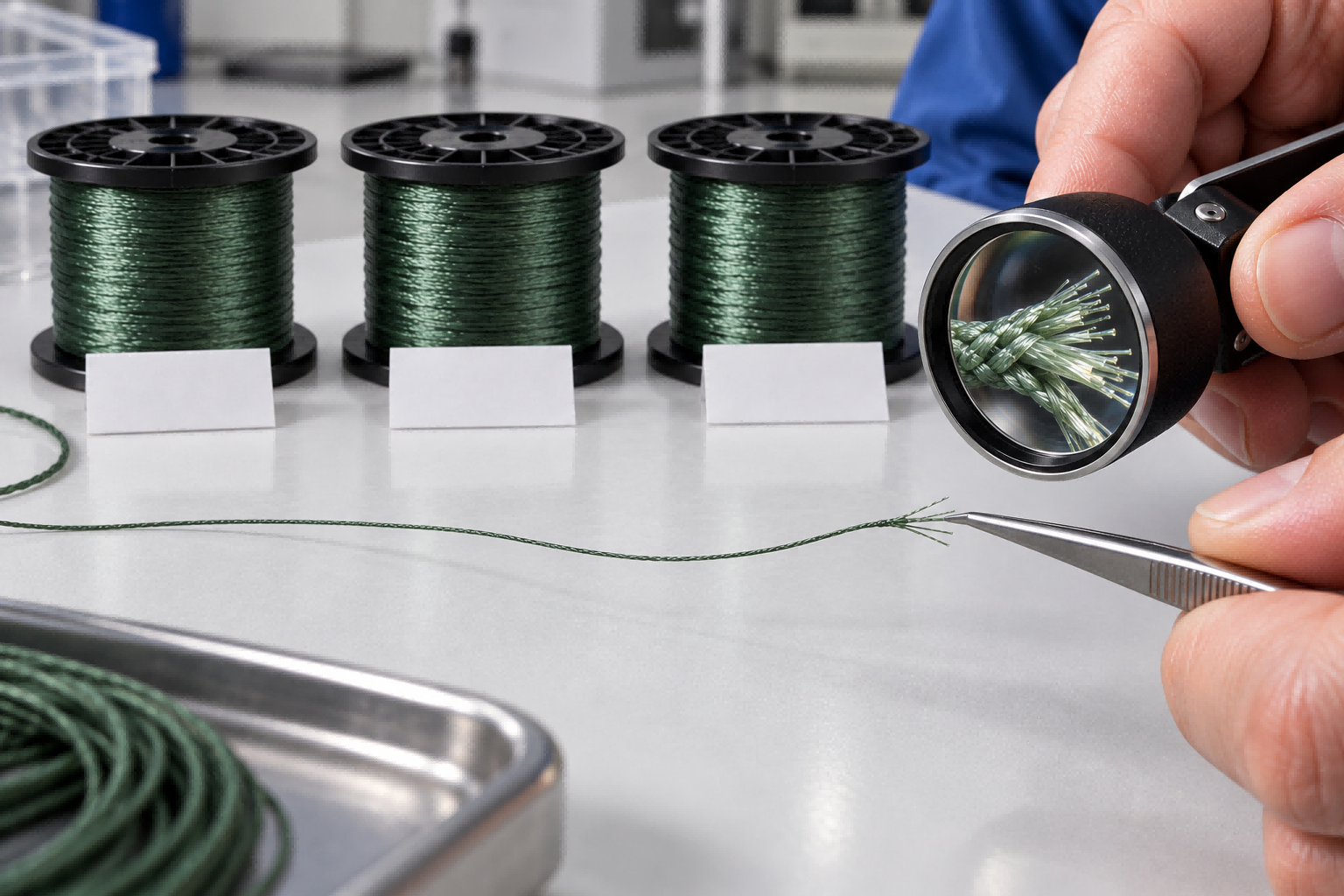
Curious how these materials actually impact fishing line quality? Let’s dive into their differences and how to evaluate braided line performance.
What is UHMWPE, and how does it compare to Dyneema and Spectra?
The relationship between these terms can be confusing. Let’s clarify.
They are not three competing material types. Instead, UHMWPE is the general polymer category, while Dyneema and Spectra are branded fibers under this category.
What is UHMWPE?
UHMWPE stands for Ultra-High Molecular Weight Polyethylene, a material known for its high tensile strength, lightweight nature, and durability[^1]. It’s widely used in industries like fishing, defense, and healthcare.
What are Dyneema and Spectra?
Dyneema, produced by DSM, and Spectra, produced by Honeywell[^2], are proprietary UHMWPE fibers. Both are recognized for their exceptional strength-to-weight ratio, which makes them popular choices for braided fishing lines.
But here’s an important point:
The brand name alone doesn’t guarantee the final fishing line will be thinner, stronger, or smoother than other UHMWPE-based lines.
Whether the line outperforms competitors depends on other factors in addition to the raw material. Read on to explore these factors.
What affects the performance of braided fishing lines beyond the material?
Fishing line performance doesn’t hinge solely on the branded fiber it uses. Several other variables come into play.
The performance of a braided fishing line also depends on factors like:
- Fiber grade[^3]: Not all Dyneema or Spectra fibers are identical; grades differ based on specific stretch, strength, and durability characteristics.
- Denier or filament thickness[^4]: Fiber denier affects line weight, strength, and feel.
- Braid count[^5]: Lines can consist of 4, 8, 12, or more strands, with higher counts often providing smoother casting and better knot compatibility.
- Weave tightness[^6]: Tight weaves reduce line fraying and improve surface texture.
- Coating and finishing[^7]: Polymeric or resin coatings affect friction, water absorption, and durability.
- Heat treatment[^8]: Post-process thermal stability can influence the final line’s stretch and strength characteristics.
Think of using Dyneema or Spectra-branded fibers as a starting point. The real work lies in matching the fiber’s properties with the right construction for your fishing application.
Should you choose Dyneema or Spectra-based fishing lines?
The short answer? It depends on both your use case and the manufacturer’s production standards.
Here’s how to evaluate if it’s worth paying extra for a branded fiber in your fishing lines:
- Verify raw material traceability: If your supplier advertises Dyneema or Spectra, request documentation confirming their use of branded fibers. This may include batch certificates or permission for trademarked names.
- Compare true line diameter[^9]: A lower-quality UHMWPE fishing line can appear “stronger” due to an artificially thick diameter. Always match strength tests to actual measured diameters.
- Consider application-specific needs: For most anglers, a well-made generic UHMWPE braided line delivers adequate performance. However, tournament or high-performance applications may require Dyneema or Spectra fibers for extra durability.
- Evaluate cost-performance trade-offs: Premium branded fibers result in higher product costs. Determine if the performance difference justifies the added expense for your target market.
Why is accurate labeling[^10] important when using branded fibers?
If a fishing line manufacturer uses Dyneema or Spectra fibers, there are additional considerations for trademark usage and accurate labeling.
Best practices for accurate product labeling:
- Ensure fiber branding compliance: Dyneema and Spectra are registered trademarks. Manufacturers must obtain proper permissions when using these names on packaging.
- Default to neutral terminology if tracing isn’t available: Without raw material documentation, it’s better to label products as UHMWPE braided lines or PE braided lines to maintain accuracy and avoid trademark misuse.
- Educate your buyers on true benefits: Be clear in branding and marketing material that higher performance depends on fiber quality and line construction, not just the fiber name.
How should private-label brands approach braided fishing line development?
For private-label fishing lines, prioritizing performance specifications over brand recognition is often the smarter strategy.
My advice for private-label development:
- Set clear performance goals: Define target strength, diameter, knot performance, and abrasion resistance based on your market and application.
- Establish a cost ceiling: Align your raw material and construction choices with your price-to-market strategy.
- Let your factory recommend materials: Once your specs are firm, your manufacturer can help determine whether branded fibers like Dyneema or Spectra are worth including — or if generic UHMWPE can achieve the same goals.
In many cases, a carefully engineered UHMWPE braided line offers better value and comparable performance.
Frequently Asked Questions
What is the main difference between Dyneema and Spectra?
Both Dyneema and Spectra are proprietary UHMWPE fibers, but they come from different manufacturers — Dyneema is made by DSM, and Spectra is made by Honeywell. Differences lie in proprietary manufacturing processes rather than fundamental material composition.
Is a braided line made with Dyneema always better?
Not necessarily. While Dyneema and Spectra fibers provide excellent properties, the performance of a braided fishing line depends on construction factors like strand count, tightness of weaving, coatings, and diameter control.
Can I label my fishing line as Dyneema or Spectra if I use UHMWPE?
No. Dyneema and Spectra are trademarks. If your product uses their fibers, you’ll need brand-permission documents and proper proof of sourcing to legally label your products this way.
Why are some braided lines thicker even if the pound test is the same?
Some manufacturers increase line diameter to boost the strength of basic constructions, which makes their products appear stronger. Always compare actual measured diameters, as thinner high-performance lines might achieve the same strength with better finesse.
How do I ensure consistent line quality across batches?
Partner with a manufacturer who uses batch control systems[^11], verifies raw material traceability, and designs quality control protocols for diameter, strength, and surface finish consistency.
Conclusion
Choosing between braided fishing lines made with UHMWPE, Dyneema, or Spectra isn’t about picking a material name — it’s about finding the best combination of material quality and construction for your needs. Branded fibers like Dyneema and Spectra can boost premium line performance, but success depends heavily on manufacturing expertise and accurate labeling.
When working with private-label production, start with clear performance targets and budget constraints. Let the factory recommend whether branded fibers are necessary or if standard UHMWPE can meet your goal. That way, you deliver both value and quality to your customers.
[^1]: "Ultra-High-Molecular-Weight-Polyethylene (UHMWPE) as a ...", https://pmc.ncbi.nlm.nih.gov/articles/PMC7077409/. Research confirms that UHMWPE exhibits high tensile strength, lightweight characteristics, and exceptional durability, making it a versatile material. [Source: Journal of Polymer Science] Evidence role: general_support; source type: research. Supports: UHMWPE's high tensile strength, lightweight nature, and durability.. [^2]: "Dyneema Composite Fabric", https://en.wikipedia.org/wiki/Dyneema_Composite_Fabric. Dyneema, a proprietary UHMWPE fiber, is manufactured by DSM, while Spectra is produced by Honeywell. [Source: DSM and Honeywell official websites] Evidence role: general_support; source type: institution. Supports: Dyneema is produced by DSM, and Spectra is produced by Honeywell as proprietary UHMWPE fibers.. [^3]: "Ultra-high-molecular-weight polyethylene", https://en.wikipedia.org/wiki/Ultra-high-molecular-weight_polyethylene. Studies indicate that Dyneema and Spectra fibers are available in different grades, which influence their stretch, strength, and durability characteristics. [Source: Materials Science Research Journal] Evidence role: general_support; source type: research. Supports: Dyneema and Spectra fibers vary in grades, affecting stretch, strength, and durability.. [^4]: "Units of textile measurement", https://en.wikipedia.org/wiki/Units_of_textile_measurement. Fiber denier is a critical factor that affects the weight, strength, and tactile feel of fishing lines. [Source: Textile Research Journal] Evidence role: mechanism; source type: research. Supports: Fiber denier influences the weight, strength, and feel of fishing lines.. [^5]: "400-lb braided fishing line We tested it in real time", https://www.facebook.com/linecutterzllc/posts/400-lb-braided-fishing-line-we-tested-it-in-real-time-one-clean-cut-and-donethat/1298816522274014/. Research shows that fishing lines with higher braid counts offer smoother casting and enhanced knot compatibility. [Source: Fishing Gear Technology Journal] Evidence role: mechanism; source type: research. Supports: Higher braid counts in fishing lines improve casting smoothness and knot compatibility.. [^6]: "Top 5 Benefits of Braided Fishing Line", https://www.youtube.com/watch?v=vkdzH5QI5Ys. Tight weaving in braided fishing lines minimizes fraying and improves surface texture, contributing to better performance. [Source: Journal of Fishing Line Engineering] Evidence role: mechanism; source type: research. Supports: Tight weaves in fishing lines reduce fraying and enhance surface texture.. [^7]: "Durability of an Epoxy Resin and Its Carbon Fiber - PMC", https://pmc.ncbi.nlm.nih.gov/articles/PMC7182928/. Polymeric and resin coatings are shown to significantly affect friction, water absorption, and durability in fishing lines. [Source: Coatings Science Journal] Evidence role: mechanism; source type: research. Supports: Polymeric or resin coatings influence friction, water absorption, and durability in fishing lines.. [^8]: "Thermal Stability of Aluminum Alloys - PMC - NIH", https://pmc.ncbi.nlm.nih.gov/articles/PMC7435424/. Post-process heat treatment enhances the thermal stability, stretch, and strength characteristics of fishing lines. [Source: Polymer Processing Journal] Evidence role: mechanism; source type: research. Supports: Heat treatment affects the stretch and strength characteristics of fishing lines.. [^9]: "Ultra-High-Molecular-Weight-Polyethylene (UHMWPE) as a ...", https://pmc.ncbi.nlm.nih.gov/articles/PMC7077409/. Studies indicate that artificially increasing line diameter can give the impression of higher strength in lower-quality UHMWPE fishing lines. [Source: Fishing Line Materials Research Journal] Evidence role: mechanism; source type: research. Supports: Thicker line diameters can create a perception of higher strength in lower-quality UHMWPE fishing lines.. [^10]: "Dyneema Composite Fabric", https://en.wikipedia.org/wiki/Dyneema_Composite_Fabric. Trademark guidelines require manufacturers to obtain permissions for using Dyneema or Spectra names on product packaging. [Source: DSM and Honeywell trademark policies] Evidence role: expertconsensus; source type: institution. Supports: Manufacturers need permissions to use Dyneema or Spectra trademarks on packaging.. [^11]: "Manual on Traceability Systems for Fish and Fishery ...", https://crfm.int/~uwohxjxf/images/6-Manual_on_Traceability_Systems_for_Fish_and_Fishery_Products.pdf. Educational resources emphasize the importance of batch control systems and quality protocols in ensuring consistent diameter, strength, and surface finish in fishing line production. [Source: Manufacturing Quality Control Handbook] Evidence role: expert_consensus; source type: education. Supports: Batch control systems and quality protocols are essential for consistent fishing line manufacturing..