
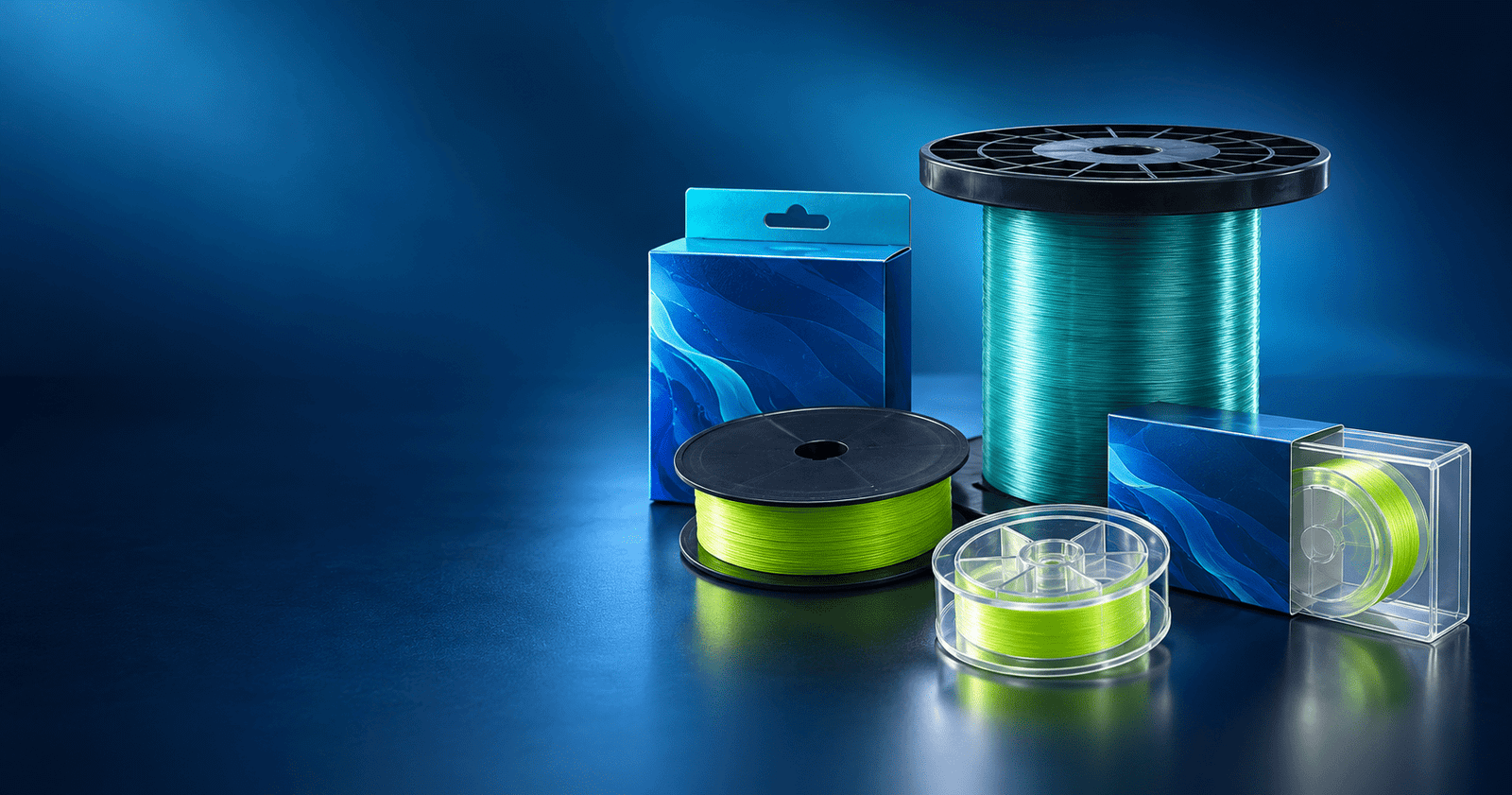
Fishing Line Packaging Options: Spools, Cards, Clamshells and Bulk Packs
When deciding on fishing line packaging options, understanding the demands of your sales channel is key. Packaging requirements differ greatly between retail stores, e-commerce platforms, wholesale distribution, and industrial use cases.[^1] Ignoring these differences can lead to higher costs or issues during sales and distribution.[^2] Let’s explore the pros and cons of common packaging types.
Fishing line packaging should first align with the sales channel before finalizing the design. Retail, e-commerce, wholesale, and industrial buyers have different expectations for durability, information density, and product presentation.[^3]
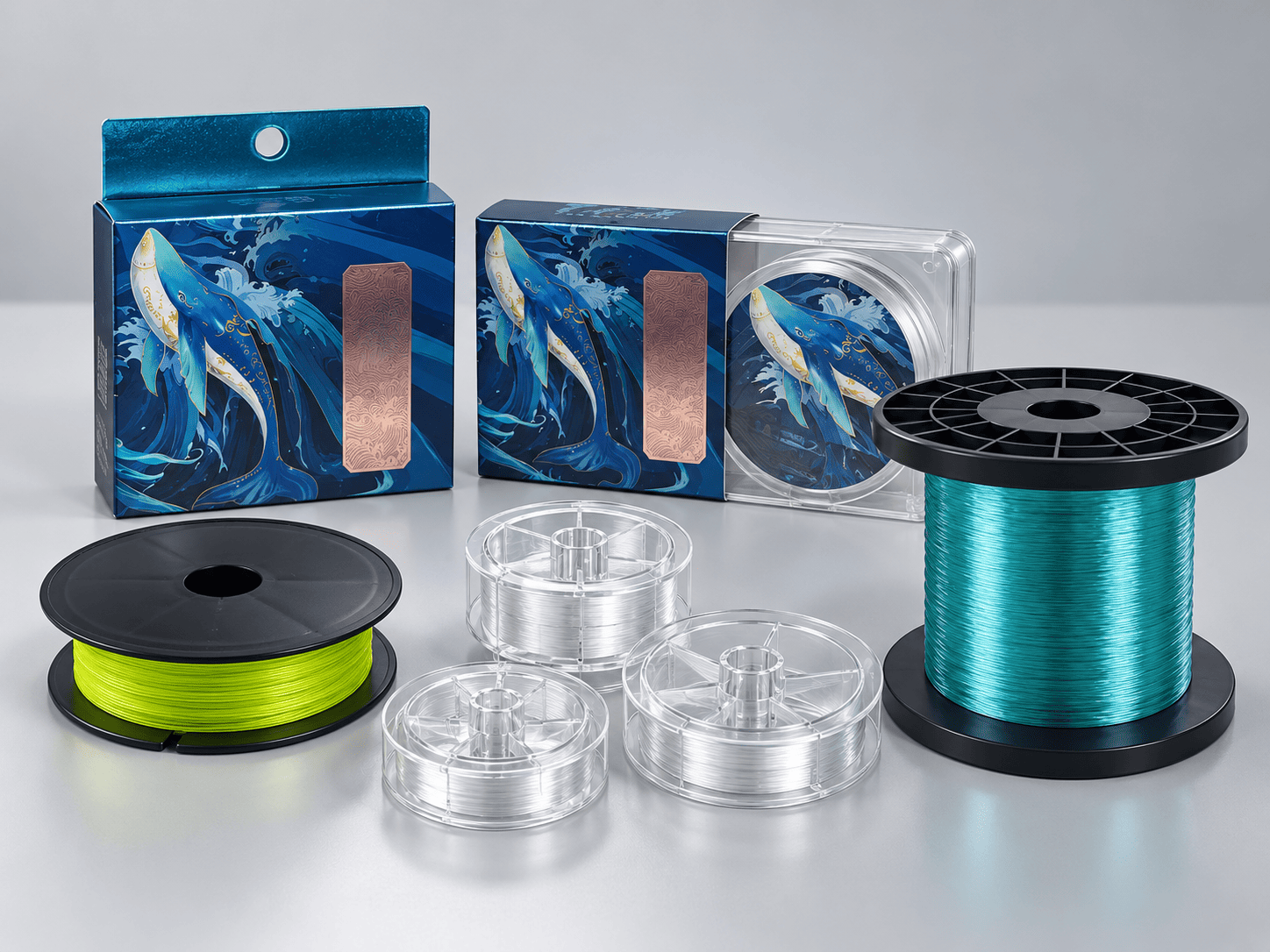
Before we explore these packaging types, let’s first answer one important question.
Why does packaging need to fit the sales channel?
Packaging is not just visual — it determines product protection, brand perception, and logistics efficiency.
If a fishing line product is packaged incorrectly, it can lead to logistical inefficiencies, low shelf visibility, higher breakage rates, or even customer dissatisfaction. For example, e-commerce packaging must focus on shipping efficiency and durability, while retail packaging prioritizes shelf appeal and tamper resistance.
Matching packaging to the sales channel ensures the product arrives intact, appeals to customers, and meets logistical requirements. Misalignment can lead to damaged goods, higher shipping costs, or lower purchase conversions.
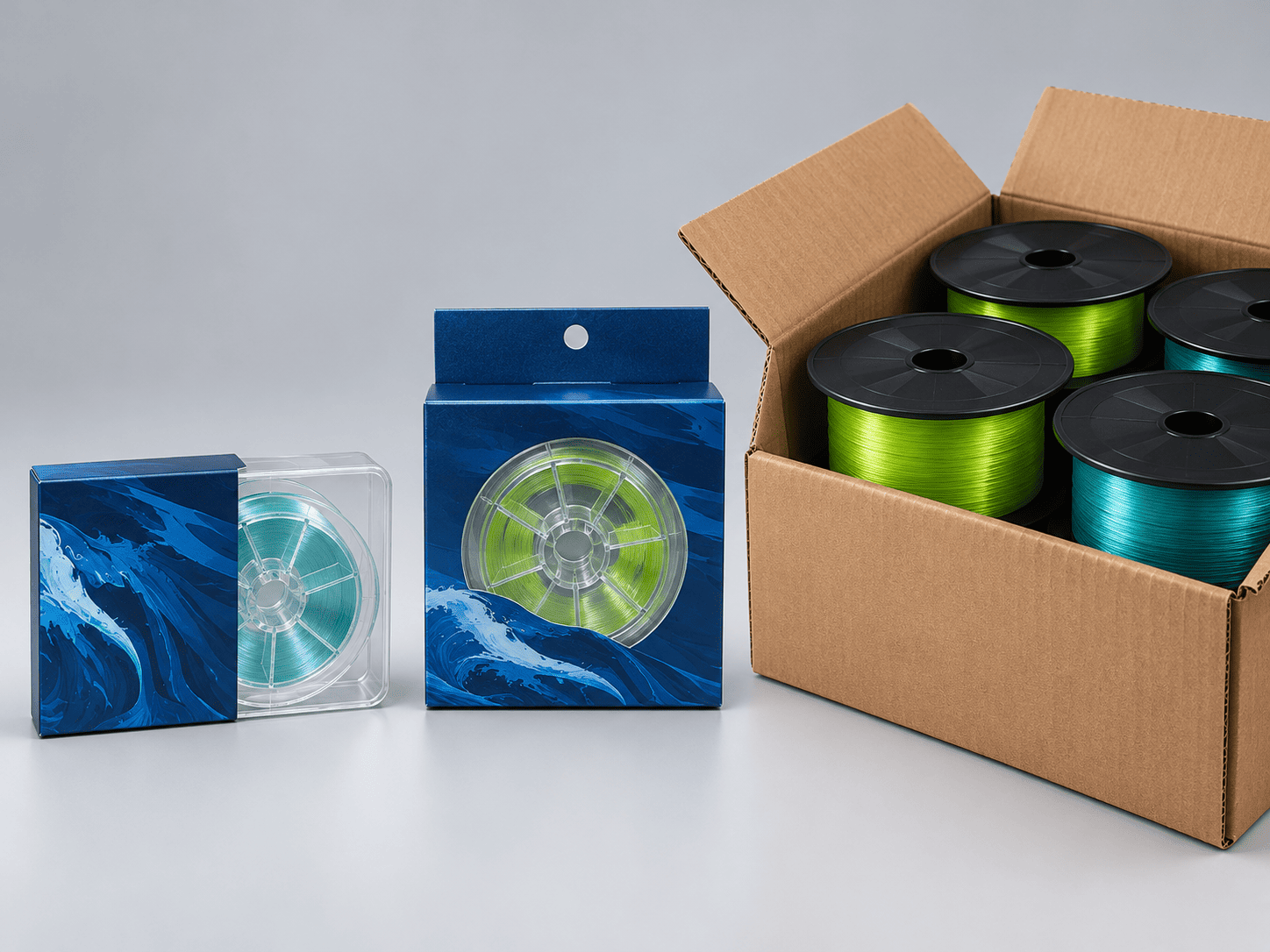
Let’s evaluate the most common packaging types, their benefits, and how appropriate they are for varying sales channels.
What are the advantages of spool-and-box packaging?
Packaging fishing lines on spools housed inside printed cardboard boxes is a versatile solution.
This method offers brands a lot of flexibility while balancing cost, presentation, and adaptability. It's relatively efficient to update packaging designs over time by changing the box artwork without altering the actual product.
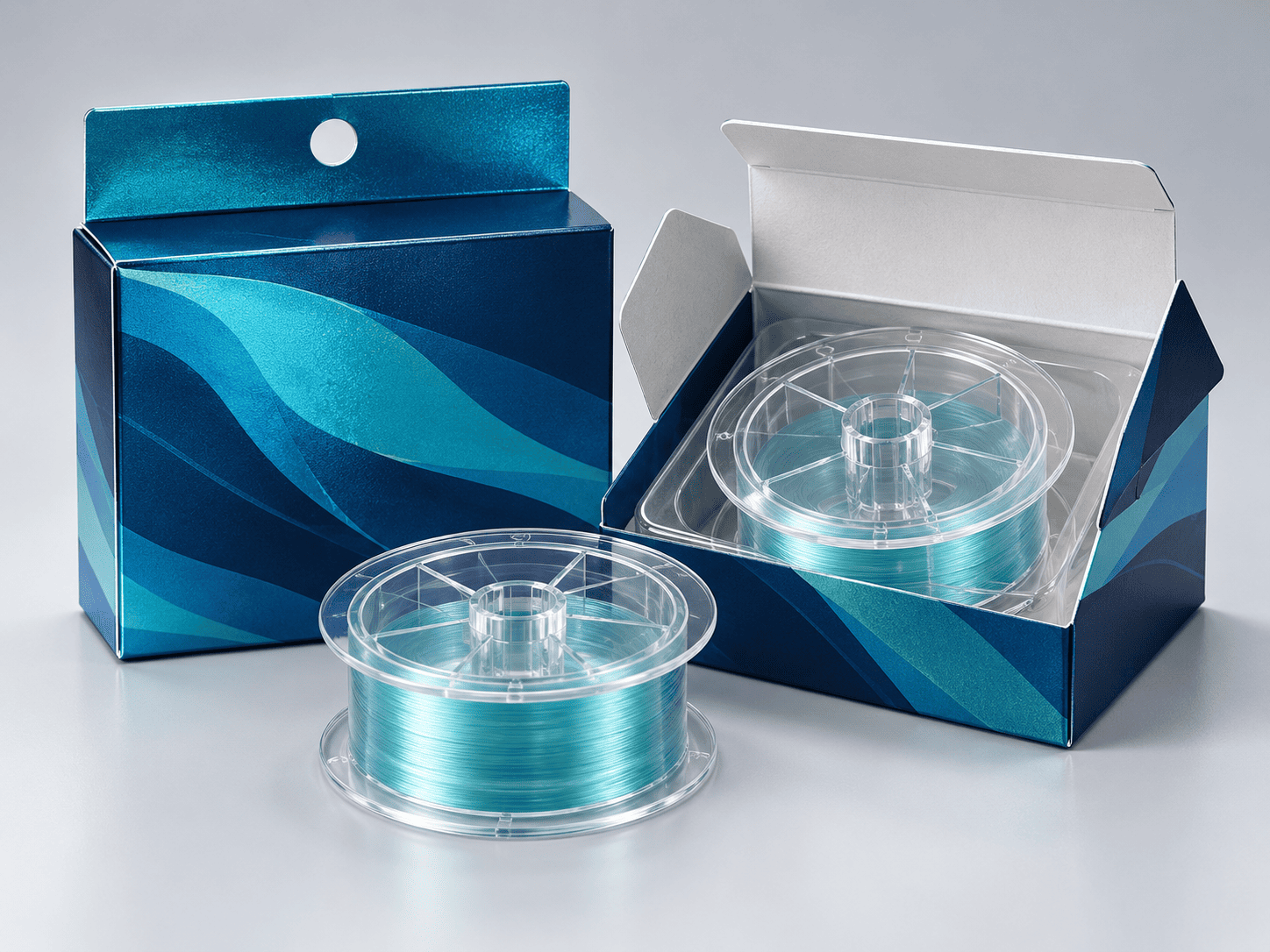
Advantages of spool-and-box packaging:
- Ease of design updates: Changing the box design is cost-effective compared to full plastic molds.
- Compact storage and shipping: Boxes stack neatly for both storage and shipping.
- Eco-friendlier material options: Cardboard can offset environmental concerns compared to full plastic packaging.
- Information space: Ample room for specifications, branding, and instructions.
Limitations:
- Does not offer as much product visibility as clamshells.
- Less tamper-proof compared to fully sealed methods, which may be a concern in high-traffic retail.
Spool-and-box packaging is suitable for brands that operate across both retail and e-commerce channels because it balances cost, appeal, and structural simplicity.
Why choose clamshell packaging?
Clamshell packaging involves encasing the fishing spool in clear molded plastic, typically paired with printed inserts. While it’s costlier than box options, it offers distinct advantages in durability and product visibility.
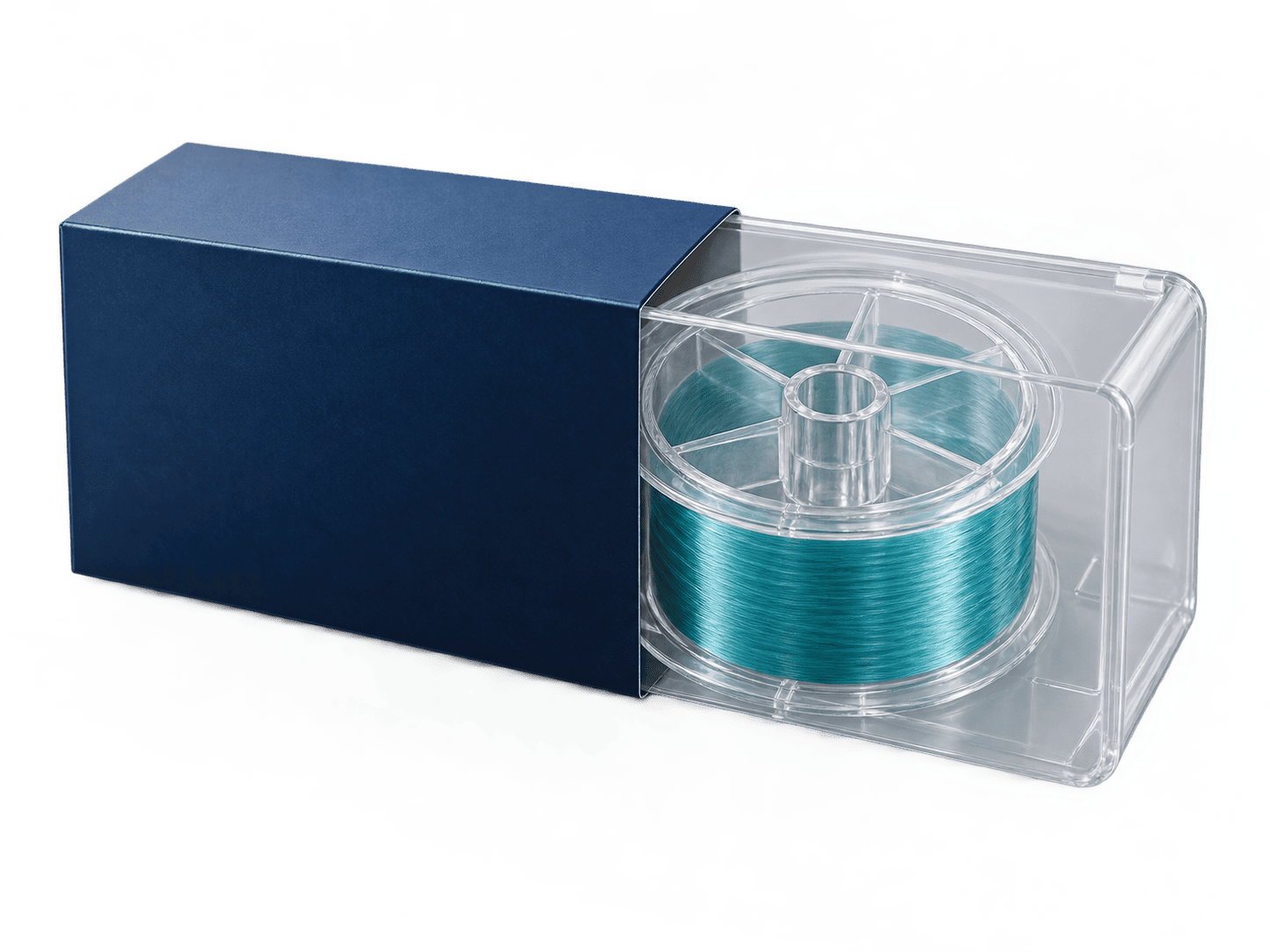
Advantages:
- Product visibility: Customers can see the product directly, which can increase retail appeal.
- Tamper resistance: Fully sealed clamshells prevent direct physical access until purchase.
- Durability: Protective plastic reduces the risk of scuffing or abrasion during transport or display.
Limitations:
- Higher tooling costs: Creating custom molds increases development time and material expense.
- Larger packaging volume: Clamshells often occupy more space, leading to higher shipping costs.
- Environmental concerns: Increased plastic content may not align with brands focused on sustainability initiatives.
This option is better suited for high-end products marketed in brick-and-mortar retail environments where tamper resistance and premium presentation outweigh added costs.
When does bulk packaging make sense?
Fishing lines packaged in bulk — such as on large spools or as plain wound coils — are often used by wholesalers, distributors, or industrial users who require efficient handling and lower costs.
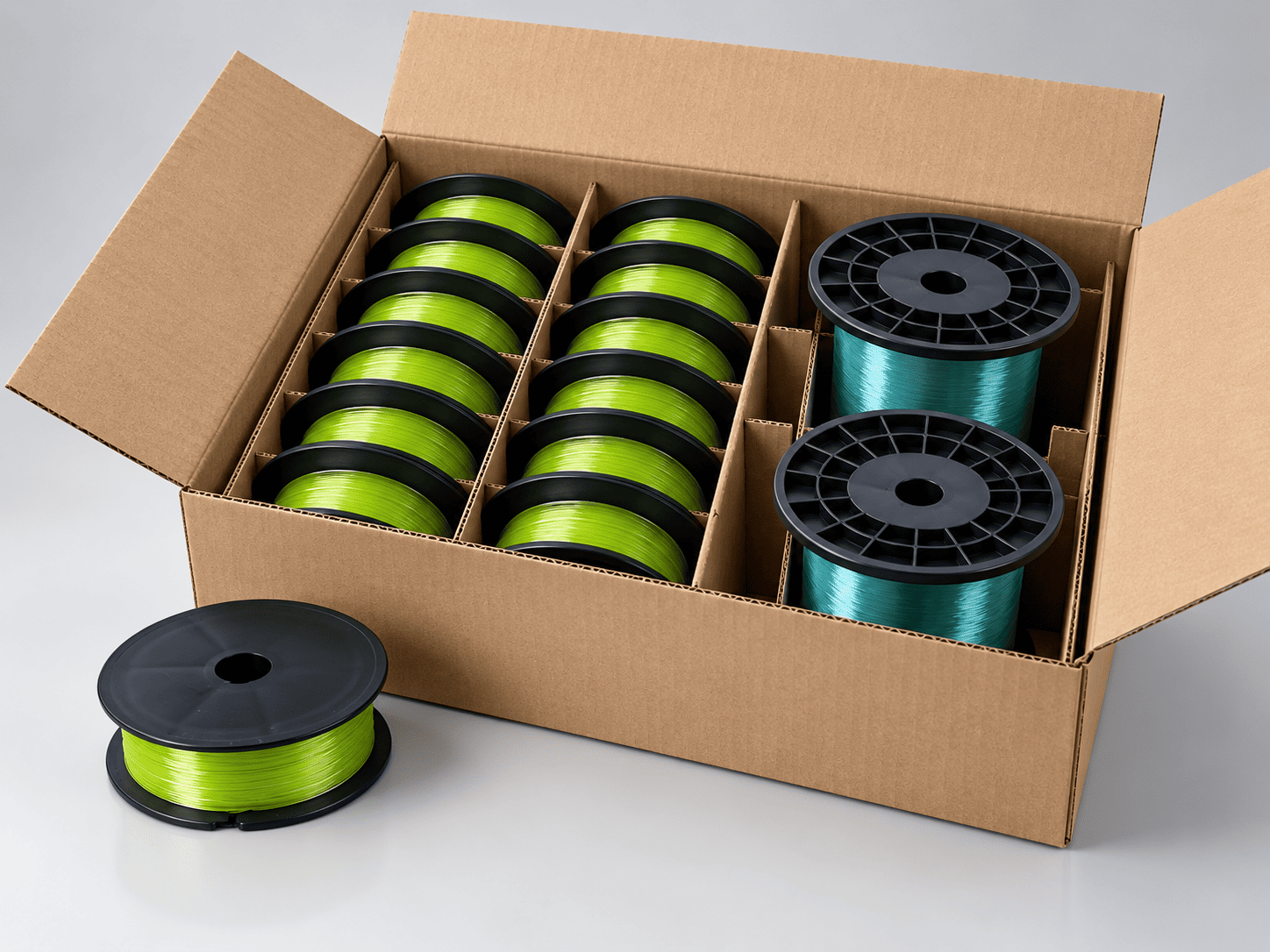
Key considerations:
- Cost efficiency: Bulk reduces per-unit costs by eliminating decorative packaging elements.
- Handling requirements: Buyers must manage post-production steps like rewinding or labeling.
- Order scale: Bulk packaging tends to suit large-scale operations where repackaging costs can be absorbed.
Applications:
- Industrial needs: Factories needing fishing lines for secondary applications.
- Wholesalers: Organizations that plan to repackage fishing lines for localized markets.
If opting for bulk packaging, it’s important to establish who is responsible for functions like rewinding and barcoding as this impacts cost and time.
What packaging costs are often overlooked?
While many focus only on the unit cost of packaging (e.g., price per box or clamshell), a thorough evaluation should include hidden factors such as labor, shipping, and assembly efficiency.
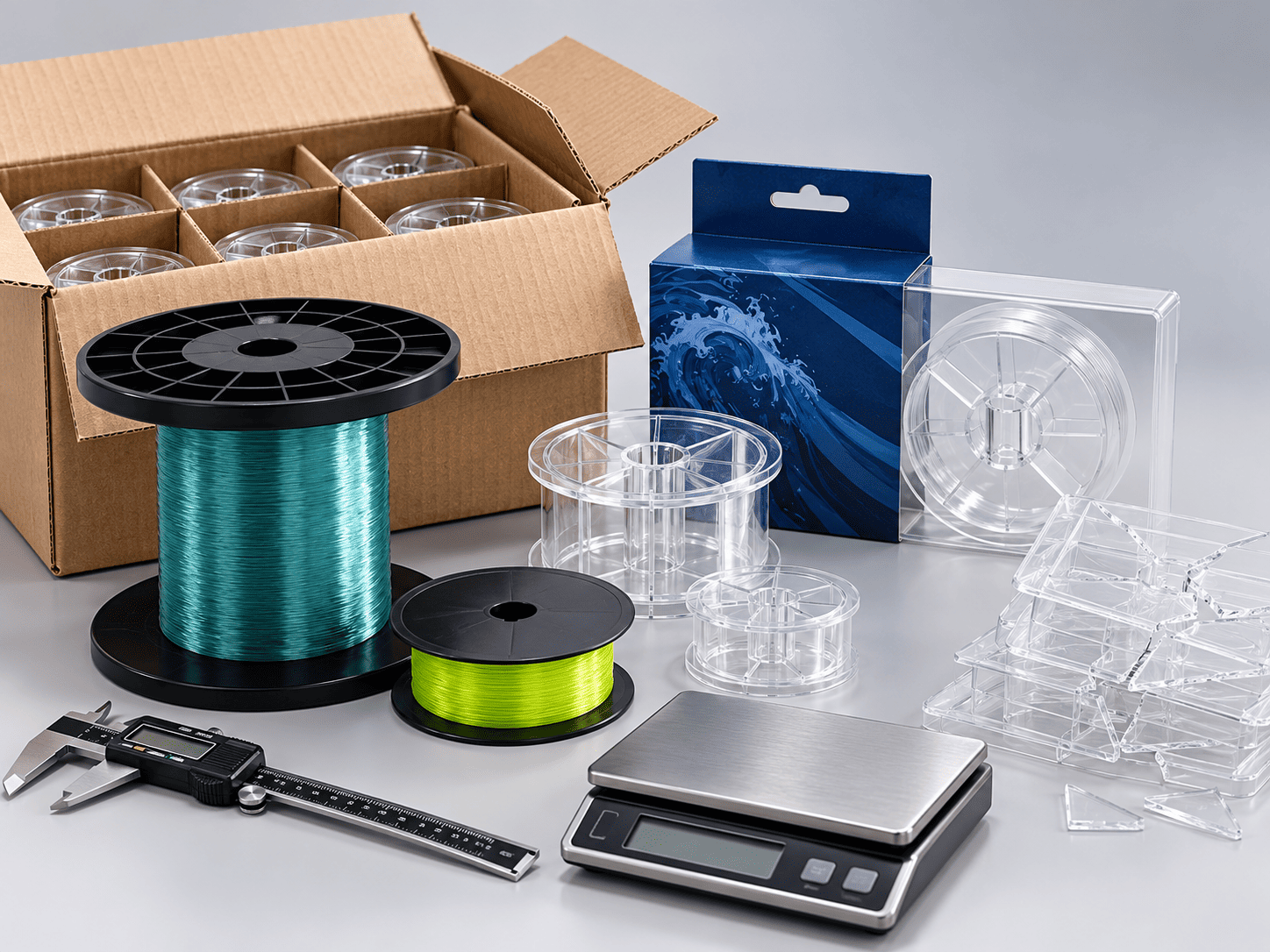
Overlooked Factors Include:
- Spool molds: Custom spools may require tooling investment.
- Barcode positioning and visibility: Poor positioning may affect scanning during logistics.
- Carton configuration: Box sizes and how items pack into cartons can affect shipping efficiency.
- Volume weight ratios: Bulky items are charged by volume, not actual weight — an inefficient design could increase freight costs.
- Assembly labor: Complex packaging takes longer to assemble, increasing production time or costs.
Before finalizing your packaging, prototype multiple options and analyze logistics impacts in addition to shelf performance.
Why should packaging samples be verified beyond flat artwork?
While it’s customary to approve printed artwork for packaging during production, flat samples don’t show the full picture. Once assembled, packaging can reveal issues with barcodes, winding alignment, or shelf performance that didn't appear in the design phase.
Always verify a fully assembled packaging sample before committing to production. This helps identify potential problems with spacing, barcodes, shelf visibility, or winding consistency.
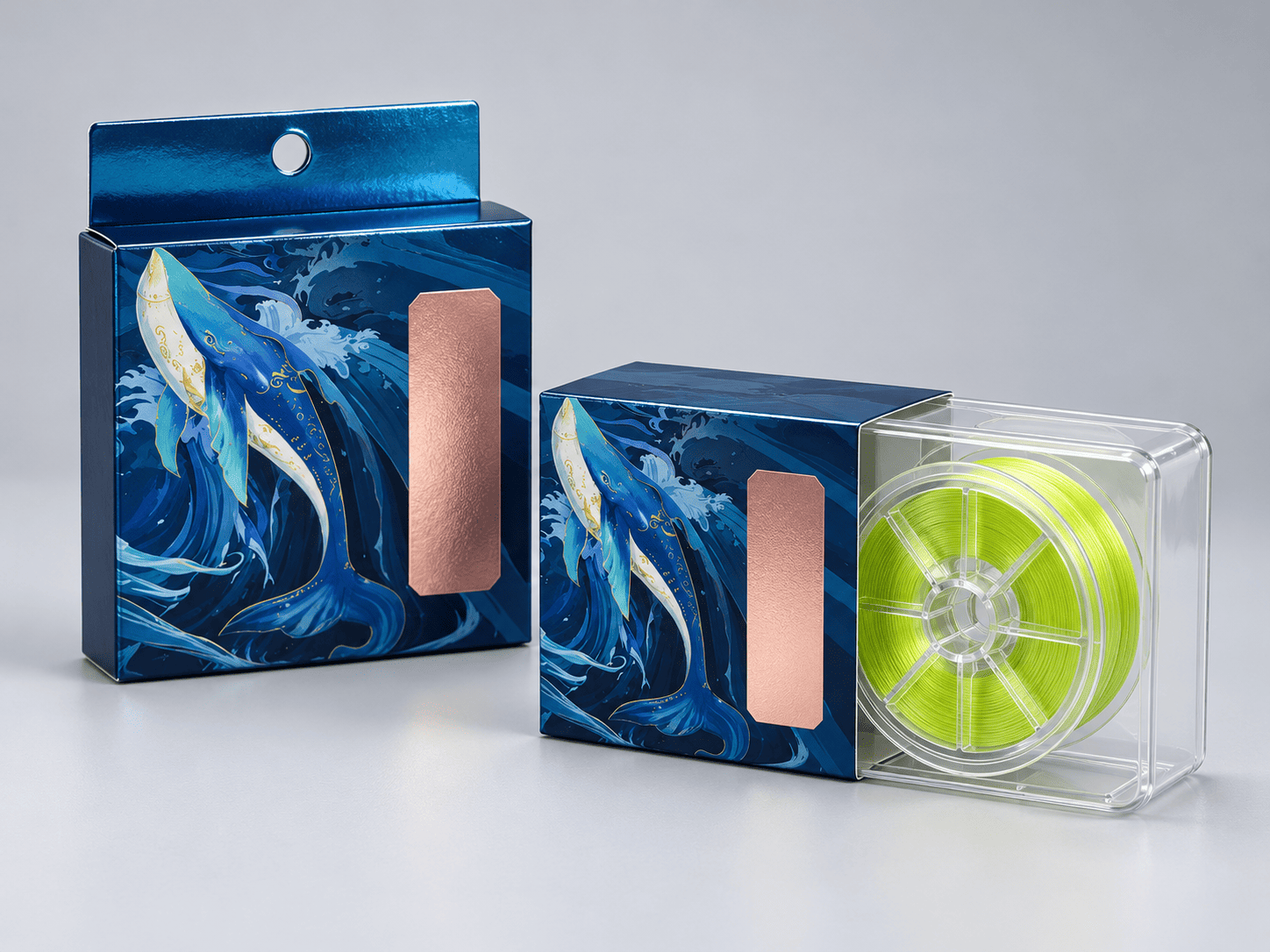
A few things to check in an assembled sample:
- Barcode scannability: Ensure the barcode is easy to scan and not obstructed.
- Winding consistency: Improper winding can leave gaps or tangles that harm customer perception.
- Shelf impact: Assess how the product appears when stacked or lined up with competitors.
Frequently Asked Questions
How do packaging choices impact shipping costs?
The size and material of packaging affect shipping costs by influencing dimensional weight and protection needs. For example, clamshells often result in higher costs due to volumetric inefficiencies, while box packaging is more compact for transport.
Can the same line be packaged differently based on the sales channel?
Yes, fishing lines can be packaged in spools-and-boxes for retail, shrink-wrapped for e-commerce, or bulk-packed for wholesalers. It’s common for brands to design packaging variants to meet diverse channel needs.
What’s the minimum order volume for custom designs like printed boxes or labels?
This depends on supplier requirements but typically ranges from 40–50 spools per specification for basic designs. However, additional customization (e.g., dyed lines or softening treatments) may require larger minimums.
Is biodegradable packaging available for fishing lines?
Yes, some manufacturers offer biodegradable cardboard or reduced-plastic options. However, the choice depends on the target sales region and whether sustainability aligns with customer expectations.
How do I validate the durability of my chosen packaging?
You can perform simulated shipping tests — such as vibration, drop, and compression testing — to assess whether the packaging sufficiently protects the fishing lines during transport.
Conclusion
Selecting the right fishing line packaging ensures that your product appeals to its target market while also balancing protection, logistics, and brand identity. Common options include spool-and-box packaging for flexibility, clamshells for retail visibility, and bulk packs for wholesale efficiency. Verifying full packaging samples — not just artwork — can identify and resolve issues before production, ensuring that your products succeed both on the shelf and along the supply chain.
For brands and distributors requiring tailored fishing line packaging solutions, we specialize in creating customized configurations. Let’s work together to develop packaging that fits your sales channel and enhances your product.
[^1]: "Packaging and Labeling Requirements FAQs", https://www.nist.gov/pml/owm/faqs/packaging-and-labeling-requirements-faqs. Research studies on packaging logistics and sales channels confirm that retail, e-commerce, wholesale, and industrial sectors have distinct packaging needs due to factors like durability, visibility, and shipping efficiency. Evidence role: general_support; source type: research. Supports: Packaging requirements vary significantly across different sales channels.. Scope note: The source may provide general trends rather than specific examples for fishing line packaging. [^2]: "Alignment in Cross-Functional and Cross-Firm Supply ...", https://www.hbs.edu/ris/Publication%20Files/07-058.pdf. Case studies in supply chain management highlight instances where inappropriate packaging led to increased costs and operational challenges. Evidence role: case_reference; source type: research. Supports: Mismatched packaging can result in higher costs and logistical inefficiencies.. Scope note: The examples may not directly involve fishing line products but illustrate general principles. [^3]: "The Impact of Visual Elements of Packaging Design on ... - PMC", https://pmc.ncbi.nlm.nih.gov/articles/PMC11851823/. Research on consumer packaging confirms that buyer expectations vary across retail, e-commerce, wholesale, and industrial channels. Evidence role: expert_consensus; source type: research. Supports: Different sales channels have varying expectations for packaging durability, information, and presentation.. Scope note: The source may provide general trends rather than specific examples for fishing line packaging. [^4]: "Top 5 advantages of custom retail packaging boxes", https://www.ybyboxes.com/top-5-advantages-of-custom-retail-packaging-boxes/?srsltid=AU7gw4X1ruksp_C-coiO1x_0ArxNj4f1DtYGJlzwpSqE0c2q69CWvRty. Research on packaging solutions for consumer goods supports the suitability of spool-and-box designs for retail due to their flexibility and ease of assembly. Evidence role: general_support; source type: research. Supports: Spool-and-box packaging is lightweight, customizable, and suitable for retail environments.. Scope note: The source may not specifically address fishing line products. [^5]: "The Advantages of Clamshell Packaging", https://www.plasticingenuity.com/blog/advantages-clamshell-packaging/. Studies on packaging materials confirm that clamshell designs offer visibility and security at the expense of higher costs and plastic usage. Evidence role: general_support; source type: research. Supports: Clamshell packaging enhances product visibility and tamper resistance but increases costs and environmental impact.. Scope note: The findings may apply broadly to consumer goods rather than fishing lines specifically. [^6]: "Reduce and Reuse: The Hidden Challenges of Bulk Packaging", https://tci.cornell.edu/?blog=reduce-and-reuse-the-hidden-challenges-of-bulk-packaging. Research on bulk packaging highlights cost savings and the operational trade-offs for buyers, such as additional handling requirements. Evidence role: general_support; source type: research. Supports: Bulk packaging reduces costs but shifts responsibilities like labeling and traceability to buyers.. Scope note: The source may not focus specifically on fishing line products. [^7]: "The hidden costs of packaging that mean you could pay ...", https://larsonpkg.com/articles/the-hidden-costs-of-packaging-that-mean-you-could-pay-more-than-you-bargained-for/. Educational materials on packaging economics outline hidden costs such as labor, logistics, and tooling that contribute to total expenses. Evidence role: general_support; source type: education. Supports: Packaging costs include material price and additional factors like labor and logistics.. Scope note: The source may provide general insights rather than specific data for fishing line packaging. [^8]: "How to Test Custom Packaging Samples for Quality Assurance", https://www.paramountglobal.com/knowledge/test-custom-packaging-samples/. Case studies in packaging design emphasize the importance of sample verification to avoid costly errors and inefficiencies. Evidence role: case_reference; source type: research. Supports: Skipping packaging sample verification can result in rework, buyer dissatisfaction, and production inefficiencies.. Scope note: The examples may not directly involve fishing line products but illustrate general principles.