Why a Fishing Line Samples Can Pass Testing but Fail in Mass Production
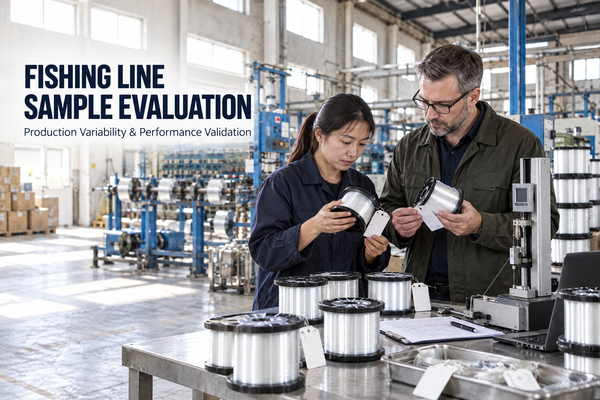
Evaluating a fishing line sample isn’t just about surface characteristics. While a sample might pass initial testing, unexpected challenges often arise during mass production[^1]. These issues stem from production-scale variables—equipment, processes, raw material batches, and testing inconsistencies. Let’s explore why confirming a sample doesn’t guarantee mass production success.
A fishing line sample can pass testing due to small-scale optimization, selective sampling, or ideal testing conditions. However, mass production introduces variables like equipment, labor shifts, material inconsistencies, and environmental factors, which may lead to deviations in quality. Addressing these risks demands thorough production verification and quality control measures.
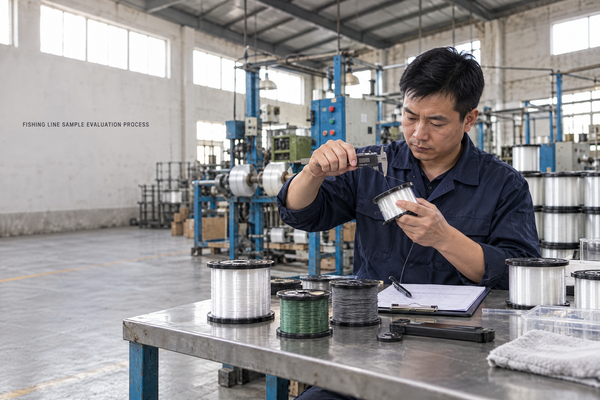
When transitioning from sample approval to scaled production, understanding the differences between small-batch testing and mass production complexities is crucial. In this article, I’ll break down potential risks and practical practices for manufacturers and buyers alike to ensure consistent product performance.
Why does a fishing line sample pass testing but fail in mass production?
A seemingly perfect sample can fail during mass production for reasons manufacturers and buyers often overlook.
Samples are typically produced under ideal conditions to optimize characteristics like breaking strength, diameter uniformity, and knot performance. Mass production, however, introduces variability in raw materials, machinery setup, labor shifts, and environmental factors—none of which exist during sample creation. This can lead to performance failures without proper controls.
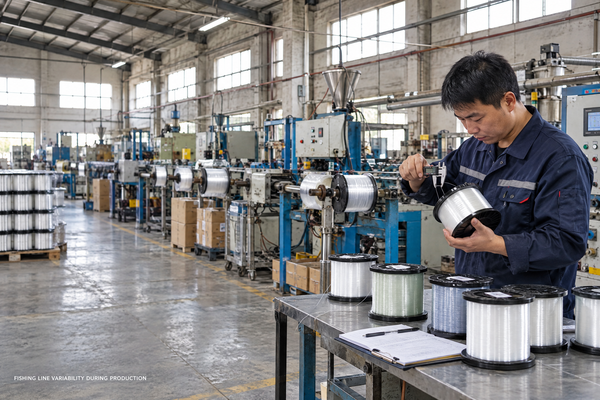
Reasons samples don’t predict mass production results
Samples often represent controlled conditions:
- Selected materials: Premium material batches may be used initially[^2]. Real-world production introduces batch-to-batch variation.
- Optimized equipment settings: A sample may be manufactured on equipment running at low speed or with special calibration—settings not feasible at scale.
- Small batch focus: Less chance for unnoticed defects due to heightened attention on limited quantities.
Mass production brings new challenges:
- Equipment-scale limits: Factory machines run faster, introducing tension inconsistencies[^3] and diameter irregularities.
- Batching and shifts: Multiple operator shifts introduce variability.
- Supplier consistency: Raw material batch differences become noticeable.
- Environmental impact: Humidity and temperature in factories impact polymer-based materials[^4].
Effective fishing line manufacturing requires bridging these gaps with rigorous control mechanisms.
What should field samples verify before mass production?
A sample can mislead buyers if it doesn’t predict performance characteristics accurately.
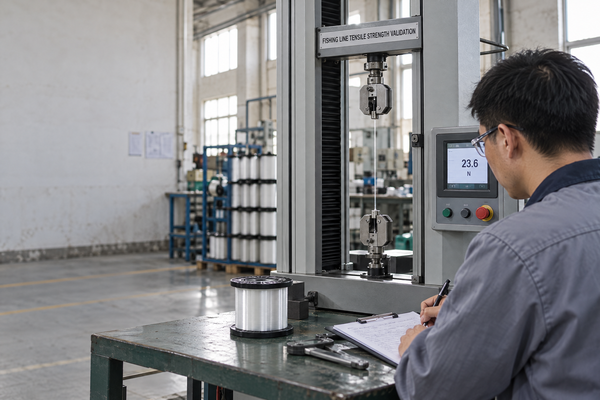
While samples are useful for testing hand feel, visual characteristics, and specific traits, they don’t encapsulate hidden performance metrics essential for fishing line quality—such as diameter precision, tensile strength, knot stability, and abrasion resistance. Numerical limits for these traits should accompany sample approval.
Confirming hidden performance metrics
Samples can verify:
- Touch and handling: Does the material feel suitable for its intended market?
- Appearance characteristics: Color accuracy, transparency, or texture.
Samples cannot guarantee:
- Diameter precision[^5]: Small deviations impact line length, spool capacity, and strength ratings.
- Tensile strength[^6]: Actual breaking points must be cross-tested with batch control data.
- Abrasion resistance[^7]: Cannot be judged by visual inspection alone—requires test cycles against stress surfaces.
- Knot durability[^8]: Field-tested environments often reveal knot-line weaknesses more effectively.
Buyers should complement visual inspections with data-based verification plans tied to real-world durability metrics.
How does mass production variability impact fishing lines?
The transition to full-scale production reveals unseen risks.
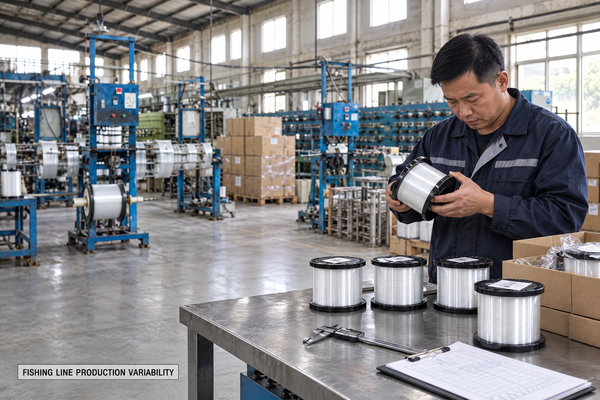
In mass production, raw material changes, machine calibrations, manufacturing fluctuations, and packaging setups combine to create variations that can degrade finished product quality. Production parameter controls and first-sample verification help manufacturers identify and avoid such problems early on.
Managing variability through production controls
Potential production variables:
- Raw material changes[^9]: Supplier inputs vary slightly by batch, affecting consistency.
- Operator error[^10]: Human intervention in machine operation can introduce overlooked flaws.
- Equipment wear: Prolonged use alters production outcomes.
- Color adjustments: Dye quality shifts impact aesthetic features irregularly.
Solutions:
- First-piece verification[^11]: Immediately evaluate the first spool of production using full mechanical tests—diameter, tension, and abrasion resistance.
- Batch sampling control[^12]: Sample regularly across production timelines and machine stations. Early detection prevents costly reworks.
- Recorded traceability: Retain both tested and untouched samples from batches. This ensures performance concerns translate into engineering fixes rather than guesswork.
Consistency at scale begins with scaling sample analysis protocols across all production factors.
How should fishing line buyers ensure quality?
Buyers play a role in verifying pre-approval processes.
Fishing line buyers should treat sample approval as a preliminary step. Comprehensive quality strategies—like confirmed first-piece tests after material changes—are essential. Coordination with manufacturing partners early in production allows buyers to influence testing feedback loops efficiently.

Essential buyer practices:
- Define rigid numerical tolerances for breaking strength, knot strength, diameter, and spool lengths before approval.
- Collaborate with manufacturers to test any traced production issues visibly highlighted during the pilot phase.
- Build mutual traceable audit accountability measures—this minimizes complaints escalating later into corrections requiring entire batch recalls.
Such actions prioritize process transparency and trust.
Frequently Asked Questions
Why can mass production fail even if samples are perfect?
Small-batch sample testing doesn’t account for equipment limits, material batch changes, environmental impacts, or operator errors—all of which can affect consistency in scaled production.
How can I trust a sample to predict product quality?
Pair visual sample approval with strict numerical limits for hidden metrics such as line diameter, tensile strength, and winding accuracy. Use production feedback loops to verify consistency.
Should every spool undergo testing during production?
Testing every spool isn’t practical—but batch sampling at regular intervals across shifts, machine lines, and production batches helps ensure consistent quality.
Conclusion
Fishing line samples often serve as a foundation for product approval, but they don’t define mass production success on their own. Variables like equipment settings, material inputs, labor shifts, and environmental factors can easily introduce inconsistencies. To ensure fishing line quality at scale, I recommend implementing detailed numerical performance tolerances during sample testing, performing first-piece verification, and relying on comprehensive production batch sampling.
At Qiaohui Industrial Monofilament, we specialize in bridging the gap between sample approval and reliable mass production. Reach out to us to ensure your fishing lines perform with consistency both in testing and on the market.
[^1]: "18 Challenges the Manufacturing Industry Faces in 2026", https://www.netsuite.com/portal/resource/articles/erp/manufacturing-industry-challenges.shtml. Mass production often involves variables such as equipment wear, material inconsistencies, and operator errors, which are less prominent in small-scale testing. See educational resources on manufacturing processes for further details. Evidence role: general_support; source type: education. Supports: Mass production introduces challenges that differ from small-scale testing conditions.. [^2]: "GMP Guidelines/Inspection Checklist for Cosmetics", https://www.fda.gov/cosmetics/cosmetics-guidance-documents/good-manufacturing-practice-gmp-guidelinesinspection-checklist-cosmetics. Research on manufacturing practices indicates that initial samples often use premium materials to showcase product capabilities. This practice may not reflect mass production conditions. Evidence role: general_support; source type: research. Supports: Manufacturers may use higher-quality materials for initial product samples to optimize performance.. Scope note: The source may focus on specific industries rather than fishing line manufacturing. [^3]: "Effect of Machine Speed on Yarn Input Tension and 'On- ...", https://www.academia.edu/99891976/Effect_of_Machine_Speed_on_Yarn_Input_Tension_and_On_Machine_Course_Length_for_a_Circular_Weft_Knitting_Machine_with_Positive_Storage_Feeding. Studies on manufacturing processes show that increased machine speeds can lead to material stress and inconsistencies, particularly in tension-sensitive products. Evidence role: mechanism; source type: research. Supports: Higher machine speeds can introduce tension inconsistencies in materials during production.. Scope note: The findings may vary depending on the specific material and production setup. [^4]: "Effect of temperature and humidity on mechanical properties ...", https://pmc.ncbi.nlm.nih.gov/articles/PMC11199615/. Research indicates that environmental factors such as humidity and temperature can affect polymer stability and performance during production. Evidence role: mechanism; source type: research. Supports: Humidity and temperature can alter the properties of polymer-based materials during manufacturing.. Scope note: The impact may depend on the specific type of polymer used in fishing lines. [^5]: "Effect of Fiber Diameter on Tensile Properties of Electrospun ...", https://ideaexchange.uakron.edu/mechanical_ideas/319/. Studies on fishing line performance show that diameter variations can significantly affect spool capacity and tensile strength. Evidence role: mechanism; source type: research. Supports: Diameter precision is critical for maintaining spool capacity and strength ratings in fishing lines.. Scope note: The findings may be specific to certain fishing line brands or materials. [^6]: "fishing line tests", https://www.uakron.edu/polymer/agpa-k12outreach/lesson-plans/fishing-line-tests. Research on polymer testing methods highlights the importance of tensile strength verification to ensure product reliability. Evidence role: mechanism; source type: research. Supports: Tensile strength testing is essential for verifying the breaking points of fishing lines.. Scope note: The testing methods may vary across different manufacturing setups. [^7]: "Abrasion Wear Resistance of Polymer Constructional ... - PMC", https://pmc.ncbi.nlm.nih.gov/articles/PMC7240616/. Studies on material durability emphasize the need for abrasion resistance testing to ensure long-term performance. Evidence role: mechanism; source type: research. Supports: Abrasion resistance testing involves cycles against stress surfaces to evaluate durability.. Scope note: The testing protocols may differ depending on the material and intended use. [^8]: "Mechanical testing of different knot types using high ...", https://pubmed.ncbi.nlm.nih.gov/24121875/. Case studies in fishing line testing show that field conditions often expose knot durability issues more effectively than laboratory tests. Evidence role: case_reference; source type: research. Supports: Field tests can reveal knot-line weaknesses that may not be apparent in controlled lab environments.. Scope note: Field testing results may vary based on environmental conditions and usage scenarios. [^9]: "Effect of Change in Material and Production Process on ...", https://www.academia.edu/11776526/Effect_of_Change_in_Material_and_Production_Process_on_Cycle_Time_Production_Rate_Cost_and_Impact_Strength_of_Plastic_Product. Research on manufacturing processes highlights the role of supplier consistency in maintaining product quality across batches. Evidence role: mechanism; source type: research. Supports: Raw material batch variations can affect consistency in mass production.. Scope note: The impact may depend on the specific material and production scale. [^10]: "Why Do Errors Happen? - To Err is Human - NCBI - NIH", https://www.ncbi.nlm.nih.gov/books/NBK225171/. Studies on production quality control show that human intervention can lead to inconsistencies and overlooked defects. Evidence role: mechanism; source type: research. Supports: Operator errors can introduce flaws in manufacturing processes.. Scope note: The extent of impact may vary depending on the level of automation in the production process. [^11]: "First article inspection", https://en.wikipedia.org/wiki/First_article_inspection. Educational resources on manufacturing emphasize the importance of first-piece verification to ensure production quality. Evidence role: general_support; source type: education. Supports: First-piece verification is a critical step in identifying production issues early.. [^12]: "Annex 4 WHO guidelines for sampling of pharmaceutical ...", https://www.who.int/docs/default-source/medicines/norms-and-standards/guidelines/quality-control/trs929-annex4-guidelinessamplingpharmproducts.pdf?sfvrsn=f6273f30_2. Educational materials on quality control highlight batch sampling as a key strategy for detecting production issues early. Evidence role: general_support; source type: education. Supports: Batch sampling control is an effective method for maintaining production quality and preventing reworks..