
Fishing Line MOQ: What Determines the Minimum Order Quantity?
When discussing fishing line manufacturing, the Minimum Order Quantity (MOQ) often becomes a key point in negotiations. Many customers mistakenly view MOQ as an arbitrary threshold set by factories, without fully understanding the production realities behind it. In practice, MOQ is shaped by operational constraints, material factors, and balancing efficiency with cost.[^1] Let's dive into the factors determining MOQ and explore how buyers can navigate this aspect of supplier collaboration.
The Minimum Order Quantity (MOQ) is determined by factors like raw material procurement, production setup costs, product complexity, packaging requirements, and economies of scale. Understanding these constraints helps buyers make informed decisions, negotiate effectively, and align their orders with realistic supplier capabilities.
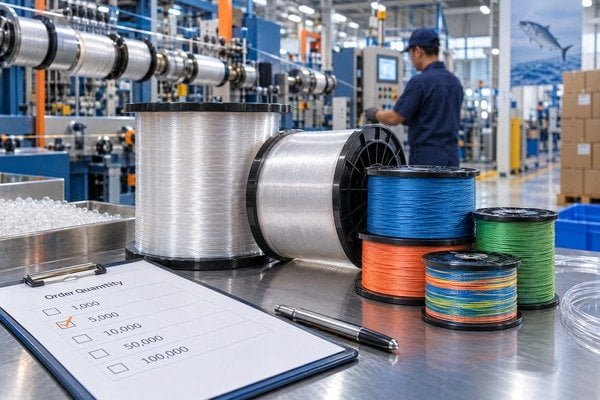
MOQ is never a "one-size-fits-all" rule—it varies based on product specification, material availability, and manufacturing processes. If you're frustrated or confused by MOQ requirements, understanding these dynamics can help clarify why some thresholds feel rigid while others are negotiable.
What are common customer misunderstandings about MOQ?
Many fishing line buyers approach MOQ with assumptions that oversimplify the realities of production.
Some customers assume suppliers apply flat MOQ thresholds across all products, regardless of specifications or complexity. Others may view MOQ as arbitrary, without realizing it reflects operational costs and material procurement requirements. Buyers also often think they can negotiate lower MOQs simply by offering higher prices, which doesn’t resolve foundational production constraints.

As someone who frequently works with fishing brands and private-label businesses, I’ve encountered these misconceptions first-hand. Here are the most common misunderstandings buyers have about MOQ:
1. Assuming uniform MOQ across product types
Fishing lines differ greatly in material, construction, and packaging requirements.[^2] A transparent nylon monofilament may have a lower MOQ compared to a custom-colored PE braided line with specific diameter tolerances. Buyers often overlook these product-specific nuances, focusing only on price or volume needs.
2. Viewing MOQ as arbitrary
MOQ thresholds aren’t designed to inconvenience customers. They often arise from real production limitations, like machine setup times, raw material supplier conditions, and packaging batch requirements. A serious buyer benefits from understanding these constraints.
3. Negotiating based solely on price
While offering a higher price might seem like a solution, the core drivers of MOQ—such as equipment calibration or minimum packaging runs—can’t always be bypassed, regardless of budget.
What drives MOQ in fishing line manufacturing?
MOQ thresholds emerge primarily from the interplay of production realities and supplier input costs.
Factors like raw material sourcing, equipment setup costs, product customization requirements, packaging constraints, and economies of scale directly impact the minimum quantity the factory can produce profitably.[^4] Each of these drivers shapes the thresholds that suppliers need to operate efficiently and maintain competitive pricing.
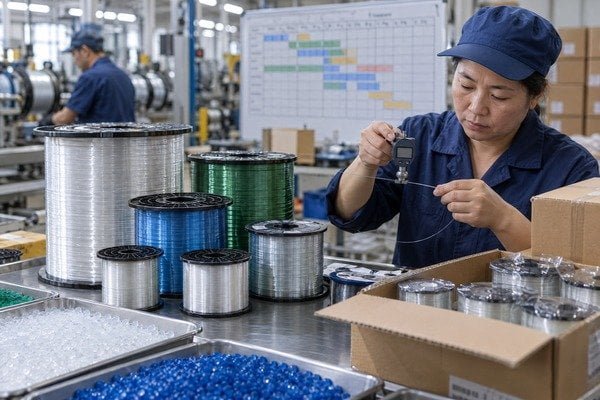
Here’s a closer look at the most significant contributors to MOQ:
Raw Material Procurement
Suppliers of raw materials (e.g., nylon and PE fibers) impose their own minimum order thresholds.[^5] Factories often need to pass these requirements on to their customers, resulting in MOQs that align with batch minimums set by upstream suppliers.
Equipment Setup Costs
Every production run requires time, labor, and materials to configure machines for the desired product specifications.[^6] For example, adjusting strand counts, dyeing processes, or diameter calibrations demands specialized work. MOQ ensures these costs are spread across batches.
Product Complexity
Customized items—like fluorocarbon lines with unique coatings or braided lines with multi-color patterns—often involve processes requiring dedicated runs. Higher MOQs ensure the added complexity doesn’t inflate per-unit costs.
Packaging Minimums
Packaging suppliers often manufacture labels, spools, and boxes in bulk, with preset minimum batch quantities.[^7] If a buyer requests fewer units than the packaging MOQ, costs spike.
Economies of Scale
Manufacturing smaller orders significantly raises per-unit costs.[^8] Larger production runs allow factories to optimize machines, use raw materials more efficiently, and consolidate labor, creating cost advantages that smaller MOQs simply cannot achieve.
How can buyers navigate MOQ demands?
Understanding MOQ drivers allows buyers to collaborate more effectively with suppliers rather than viewing thresholds as fixed obstacles.
Buyers can reduce MOQ burdens by focusing on flexible product specifications, exploring modular solutions, or timing their orders to align with other production runs. Open discussions about supplier constraints help uncover creative ways to meet both parties' needs.
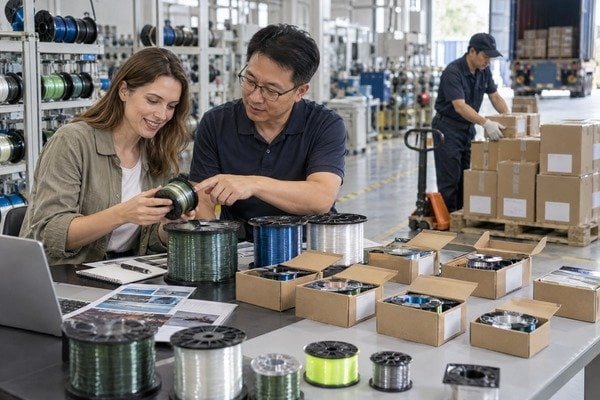
Here’s what I often recommend to clients navigating MOQ discussions:
1. Be open to flexible specifications
If product customization drives higher MOQs, consider simplifying requirements, such as using standard colors or spool designs. While this may not work for premium brands, budget-focused projects often benefit.
2. Explore modular efficiencies
Some suppliers, including us, offer modular solutions like shared production runs for common lines, standardized packaging, or combining orders from multiple clients. These approaches reduce per-customer MOQ requirements.
3. Time orders strategically
Aligning orders with other projects that use similar materials or processes helps factories optimize setups, which can lower MOQ thresholds.[^9] Advance planning goes a long way.
Collaboration starts with honest and informed discussions. Don’t hesitate to ask your supplier for explanations around their MOQ structure—it’s often the first step to uncovering mutual efficiencies.
What trade-offs exist when reducing MOQ?
Reducing MOQ might sound ideal, but it comes with compromises that buyers should weigh carefully.
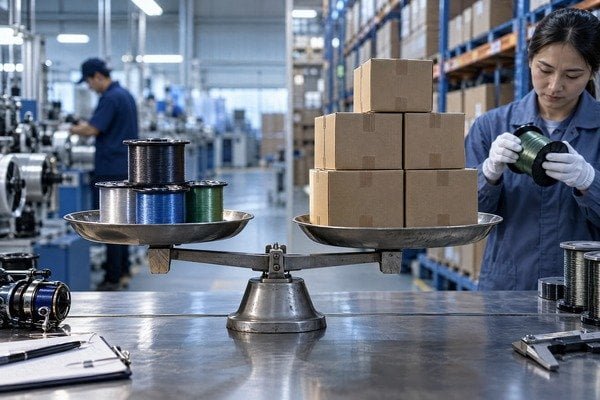
Accepting lower MOQ requirements may lead to increases in per-unit costs, longer lead times, or reduced customization.[^10] While these trade-offs are manageable depending on your market target, they require careful evaluation to avoid unintended consequences.
Higher Costs
Producing in smaller batches raises overhead, which gets reflected in higher unit prices.
Longer Lead Times
Factories may slot smaller orders into less optimal production schedules, extending delivery timelines.
Reduced Customization
MOQ reductions often require sacrificing specialized design features, limiting product differentiation in competitive markets.
Balancing these trade-offs depends on your business model and the needs of your target audience. A supplier can help guide you toward the solution most compatible with your goals.
Frequently Asked Questions
Can MOQ be different for each fishing line type?
Yes, MOQs vary based on materials, construction methods, and specifications. Transparent nylon lines often require lower MOQs compared to custom-multi-color braided lines or fluorocarbon with specific coatings.[^11]
Does MOQ always depend on price?
No, price is only one factor. MOQ stems from material procurement thresholds, equipment setup needs, packaging batch sizes, and operational efficiency.
How can small businesses manage higher MOQ requirements?
Small buyers can focus on flexible designs, collaborate with suppliers offering shared production runs, or align orders with other compatible batches to lower MOQ burdens.
Why does packaging influence MOQ?
Packaging manufacturers usually impose their own batch production limits, requiring suppliers to place minimum orders for labels, spools, and boxes. These batch limits drive MOQ thresholds.
How do large orders reduce costs?
Conclusion
MOQ in fishing line manufacturing is shaped by real-world production constraints, not arbitrary rules. From raw material procurement to equipment setup and packaging batch requirements, every component influences the factory’s ability to deliver quality products profitably.
If you understand these dynamics, you can navigate MOQ discussions with greater confidence and find solutions that suit both your business needs and supplier capabilities. Let’s work together to define fishing line specifications—and MOQs—that align perfectly with your market goals. Reach out today to start the conversation.
[^1]: "Economies of scale", https://en.wikipedia.org/wiki/Economies_of_scale. Research on manufacturing processes highlights that minimum order quantities are often determined by operational constraints, material procurement requirements, and the need to balance efficiency with cost. These factors are common across industries but may vary in specific applications. Evidence role: general_support; source type: research. Supports: Operational constraints, material factors, and efficiency-cost balance influence MOQ in manufacturing.. Scope note: The support is general and may not address fishing line manufacturing specifically. [^2]: "What Causes Anglers to Leave Behind Less Fishing Line and ...", https://ncseagrant.ncsu.edu/hooklinescience/what-causes-anglers-to-leave-behind-less-fishing-line-and-other-litter/. Educational resources on fishing line manufacturing explain that variations in material, construction, and packaging requirements influence production processes and MOQ thresholds. Evidence role: general_support; source type: education. Supports: Fishing lines vary significantly in material, construction, and packaging requirements, impacting MOQ thresholds.. Scope note: The explanation may not include specific examples of MOQ impacts. [^3]: "Customer Education Increases Trust", https://sloanreview.mit.edu/article/customer-education-increases-trust/. Educational studies on supplier-buyer relationships suggest that informed customers are more likely to engage in constructive discussions, improving collaboration and negotiation outcomes. Evidence role: expert_consensus; source type: education. Supports: Educating customers about MOQ dynamics leads to more constructive discussions and better collaboration.. Scope note: The findings may not specifically address fishing line manufacturing. [^4]: "Economies of scale", https://en.wikipedia.org/wiki/Economies_of_scale. Educational resources on manufacturing economics explain that MOQ thresholds are shaped by raw material procurement, equipment setup costs, and economies of scale, which influence profitability and operational efficiency. Evidence role: general_support; source type: education. Supports: Raw material sourcing, equipment setup costs, product customization, packaging constraints, and economies of scale impact MOQ thresholds.. Scope note: The explanation may not include specific examples from fishing line manufacturing. [^5]: "Threshold Changes - October 1st, 2025", https://www.acquisition.gov/threshold-changes. Industry reports indicate that suppliers of materials like nylon and polyethylene often set minimum order quantities, which manufacturers incorporate into their own MOQ policies. Evidence role: general_support; source type: institution. Supports: Raw material suppliers often impose minimum order thresholds that factories must adhere to.. Scope note: The data may not specifically address fishing line materials. [^6]: "What is setup cost?", https://www.accountingcoach.com/blog/what-is-setup-cost. Studies on manufacturing processes show that machine setup involves significant time, labor, and material costs, which are distributed across production batches to determine MOQ. Evidence role: mechanism; source type: research. Supports: Machine setup for production runs requires time, labor, and materials, influencing MOQ thresholds.. Scope note: The findings may not be specific to fishing line production. [^7]: "Definition of Registration Terms | PHMSA", https://www.phmsa.dot.gov/registration/definition-registration-terms. Reports from packaging industry associations confirm that suppliers typically require bulk production runs for labels, spools, and boxes, which manufacturers incorporate into their MOQ policies. Evidence role: general_support; source type: institution. Supports: Packaging suppliers often set minimum batch quantities, influencing factory MOQ thresholds.. Scope note: The data may not specifically address fishing line packaging. [^8]: "Economies of scale", https://en.wikipedia.org/wiki/Economies_of_scale. Educational resources on manufacturing economics explain that smaller production runs increase per-unit costs by reducing economies of scale and operational efficiency. Evidence role: statistic; source type: education. Supports: Smaller production orders raise per-unit costs due to inefficiencies in manufacturing.. Scope note: The explanation may not include specific examples from fishing line manufacturing. [^9]: "Raw Material Minimum Order Quantity Optimization", https://dspace.mit.edu/bitstream/handle/1721.1/121302/1240293813-MIT.pdf?sequence=1. Research on manufacturing efficiency suggests that combining orders with similar specifications can reduce setup costs and lower MOQ requirements. Evidence role: mechanism; source type: research. Supports: Aligning orders with similar projects helps factories optimize setups and lower MOQ thresholds.. Scope note: The findings may not specifically address fishing line production. [^10]: "Lower MOQ: Understanding the Hidden Costs and Trade-Offs", https://www.linkedin.com/posts/novareach-sourcing_moq-productsourcing-manufacturing-activity-7498697195752382464-Gyx-. Studies on manufacturing trade-offs indicate that reducing MOQ often results in higher per-unit costs, extended lead times, and limitations on customization due to inefficiencies in smaller production runs. Evidence role: general_support; source type: research. Supports: Lower MOQ requirements can lead to higher costs, longer lead times, or reduced customization.. Scope note: The findings may not specifically address fishing line manufacturing. [^11]: "The TRUTH! Mono VS. Braided Fishing Line!", https://www.youtube.com/watch?v=unZzUPMBQl8. Research on fishing line manufacturing indicates that simpler products like transparent nylon lines typically have lower MOQ thresholds due to reduced complexity in production and material requirements. Evidence role: general_support; source type: research. Supports: Transparent nylon lines often require lower MOQs compared to custom braided lines or fluorocarbon with coatings.. Scope note: The findings may not address specific MOQ thresholds for fishing lines. [^12]: "The market impact of large trading orders", https://haas.berkeley.edu/wp-content/uploads/hiddenImpact13.pdf. Research on manufacturing efficiency demonstrates that larger production orders reduce per-unit costs by optimizing equipment usage, labor allocation, and material consumption, achieving economies of scale. Evidence role: mechanism; source type: research. Supports: Large orders optimize equipment, labor, and materials, achieving economies of scale.. Scope note: The findings may not specifically address fishing line manufacturing.