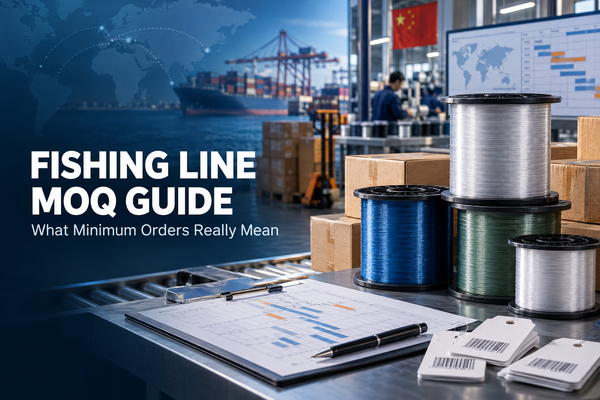
Fishing Line MOQ Guide: What Minimum Orders Really Mean
When ordering fishing lines from a manufacturer, minimum order quantities (MOQs) often dictate the feasibility of a project. The primary keyword "fishing line MOQ" represents not just a volume of product, but a balance between production efficiency, customization costs, and inventory risks. Understanding what MOQs really mean can help brands make smarter procurement decisions.
Minimum Order Quantities (MOQs) for fishing lines specify the lowest production volume required by a manufacturer to operate efficiently and economically. MOQs can apply to the fishing line material, colors, spool components, and packaging[^1], with the highest MOQ driving the final order number.
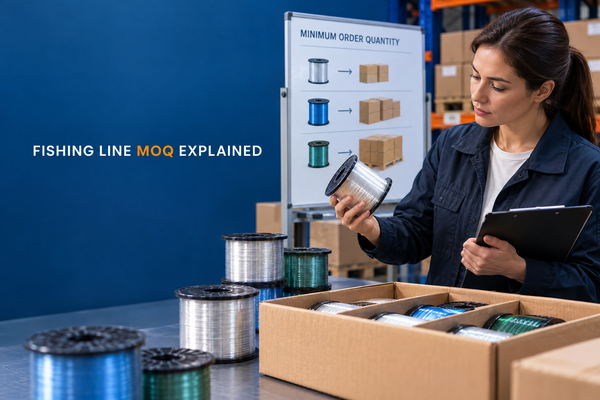
MOQs may seem inflexible, but they often reflect practical constraints around manufacturing processes. By understanding these limitations and exploring strategic options, businesses can optimize order configurations without compromising budget or warehousing space.
Why do fishing line MOQs exist?
MOQ requirements often leave buyers frustrated, but they exist for a good reason. Manufacturers set MOQs to ensure the production remains efficient and cost-effective while also minimizing waste.
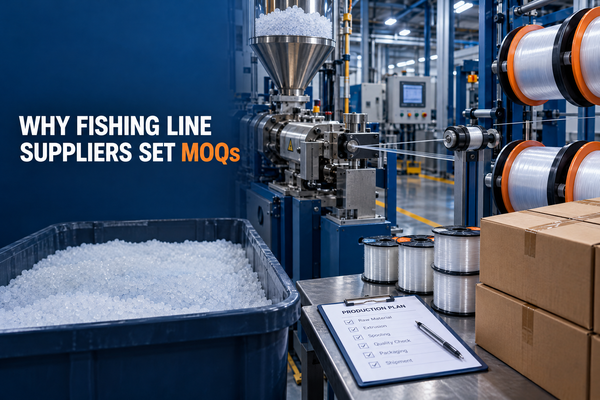
Fishing line MOQs exist because production involves multiple precision steps, including extrusion, color application, spooling, and packaging[^2], all of which incur setup costs and wastage if order volumes are too small.
Dive deeper: MOQ logistics in fishing line manufacturing
In fishing line production, every order passes through distinct operational stages — from material preparation to completion. Smaller production runs magnify inefficiencies, particularly when:
- Raw material setups involve extra cleanouts or preparation per batch.
- Line extrusion machines require complete recalibration for different diameters and specifications.
- Custom color application needs dedicated preparation (e.g., mixing dyes or changing extrusion molds).
- Post-production QC testing can't always scale down without proportionally high costs.
Consider this scenario: splitting one large order into several SKU configurations (each with its own diameter, color, and spooling) can lead to additional changeover costs, wasted material, and extended production timelines. Each combination could represent a distinctive MOQ.
How do SKU variations affect MOQs?
From a buyer's perspective, ordering multiple product variations (SKUs) allows greater market flexibility. However, each variation impacts the manufacturer’s process efficiency.
Each SKU variation (such as different line diameters, colors, and packaging styles) requires separate machine setups, raw material sourcing, and quality checks[^3], which increases the MOQ per option. Bundling shared materials helps lower MOQs.
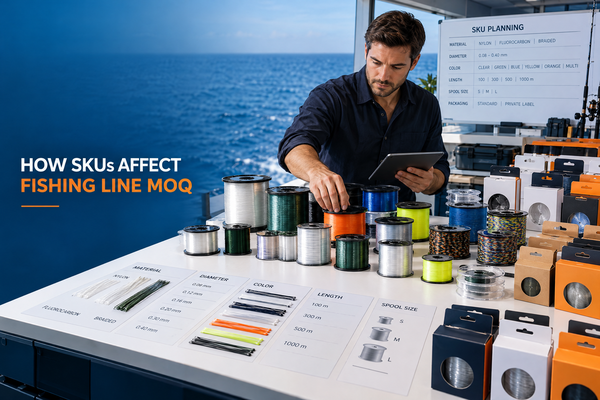
Dive deeper: MOQ versus production flexibility
SKU diversity introduces complexity into the production process. If buyers request multiple line diameters, colors, and spool configurations under one batch, the result is time-intensive production reconfiguration.
To minimize these effects:
- Standardize raw materials: Use existing extrusion materials and base stock to avoid low-volume customizations.
- Select stock components: Opt for manufacturer inventory spools, labels, and color options.
- Combine similar SKUs: Where possible, pool sub-orders sharing identical materials (e.g., transparently coated lines across different thicknesses).
For example, let’s say a fishing brand orders two SKUs (both using nylon monofilament but differing in spool packaging shape). Choosing standard spool designs rather than custom packaging cuts setup overhead and lowers MOQ thresholds.
What happens when customization increases MOQ?
Many buyers want tailor-made products, but customization adds substantial complexity to manufacturing. Custom extrusions, colors, packaging molds, and labels all raise required MOQs[^4].
Product customization, including non-standard line colors, extrusion specifications, spool shapes, and bespoke packaging, forces manufacturers to operate higher MOQs due to added material procurement and setup wastage.
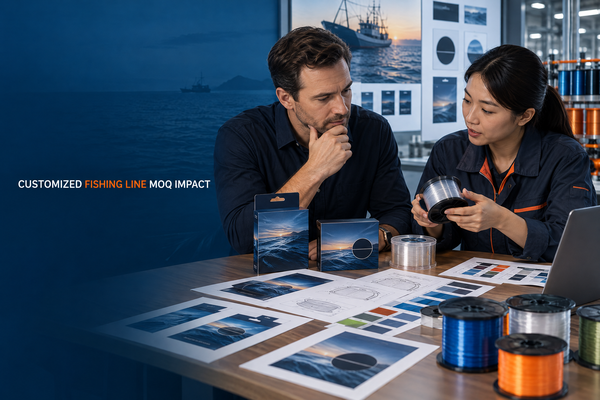
Dive deeper: Balancing custom designs with MOQ efficiency
Custom line attributes, from fluorocarbon blends to vibrant dye finishes, can distinguish fishing brands in their markets[^5]. However, these choices present trade-offs:
- Extrusion molds: Custom construction requires extrusion dies adjusted for new diameters or strand count, adding lead time and batch volume limits.
- Color application: Custom colors demand separate dye batches, which typically scale poorly for low-volume production.
- Packaging molds: Non-stock spool sizes or retail packs often require proprietary injection molds, increasing costs and pushing up MOQs.
For smaller-order customers, sticking to standard extrusion construction, pre-formulated colors, and in-stock packaging ensures both MOQ affordability and faster production cycles.
When do MOQ thresholds favor mixed trial orders?
MOQ optimization doesn’t always mean reducing order size. Mixed trial orders that pool compatible materials or packaging components often yield better efficiency[^6] than ordering fragmented product lots.
When SKUs share standardized raw materials, spool designs, or packaging, it’s easier to negotiate lower MOQs for mixed trial runs using collective batching efficiencies.
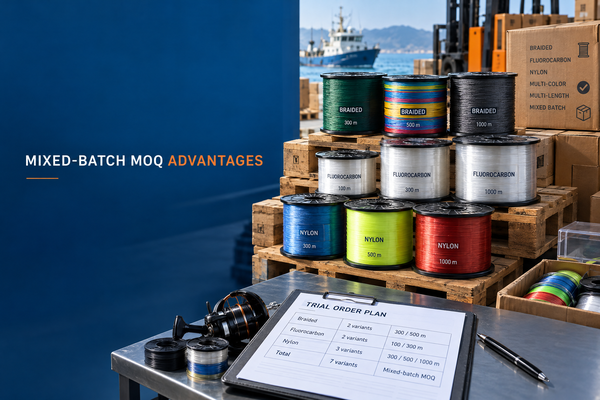
Dive deeper: MOQ alignment strategies for better trial runs
Mixed orders help brands test critical configurations while staying under MOQ penalties. To achieve this:
- Assess shared packaging components: MOQ flexibility depends on the ability to minimize unique parts (e.g., general-purpose nylon spools serving different breaking strengths).
- Confirm standardized extrusions: Make sure SKUs align closely around base production specifications (e.g., shared diameter thresholds, color uniformity).
- Batch production efficiently: Request pre-determined raw extrusion runs accommodating moderate SKU variety with minor adjustments.
As an example, combining three SKUs (nylon monofilament at 10lb, 15lb, and 20lb in transparent base colors) ensures material efficiencies compared to custom multi-color, multi-pound trial sampling.
How does inventory risk relate to MOQs?
MOQ decisions shouldn’t focus solely on initial purchase thresholds. They should also consider inventory risks, replenishment lead times, and SKU prioritization.
Choosing higher MOQs for fewer consolidated SKUs minimizes fragmented warehousing and simplifies reorder timing[^7]. Conversely, spreading orders excessively over low-MOQ SKUs can amplify stock management risks.
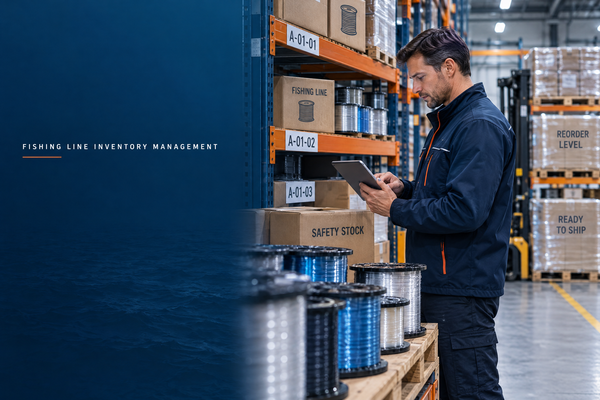
Dive deeper: Consolidate core versus fringe SKUs
When evaluating MOQs against inventory risks:
- Prioritize core SKUs maintaining cross-market relevance (e.g., best-selling diameters and colors).
- Use replenishment lead time as an MOQ factor — high-risk markets depend on SKU simplicity for restock continuity.
- Treat fringe SKUs as trial-only fulfillments arrangement rather than dispersed coverage efforts.
For example, ordering one standard spool configuration carrying universal tournament specifications serves broader retail sales with MOQ robustness versus speculative niche SKU fragmentation.
Frequently Asked Questions
What’s the lowest MOQ for fishing line production?
MOQs for fishing line production depend on raw materials and component usage[^8]. For standardized materials, manufacturers might offer trial orders as low as 30kg, but completely custom extrusions, dyes, and spools require MOQs up to 200kg or higher.
Can MOQ thresholds change mid-order?
Yes. Factors like SKU changes, material replacements, or special packaging requests can alter MOQ thresholds. Manufacturers sometimes reevaluate trial flexibility if overlapping material efficiencies improve scaling.
How do materials influence MOQs?
Materials define extrusion, color blending, and operational readiness, all impacting MOQ thresholds. Using stock nylon, fluorocarbon, or PE materials lowers MOQs compared to proprietary blends[^9].
Do larger orders always benefit pricing?
Not always. Scaling benefits apply primarily within unified production runs[^10]. Fragmented large orders across several diverse configurations could erode cost efficiency.
Are MOQs negotiable?
MOQ negotiation hinges on material compatibility, batch logistics, and the supplier’s capacity[^11]. Businesses focusing on shared standardization across SKUs are likelier to succeed in MOQ discussions.
Conclusion
Fishing line MOQs reflect the balance between manufacturing costs, operational efficiency, and SKU complexity. By understanding how material setups, SKU customization, trial batching, and inventory risks influence MOQs, buyers can align procurement strategies with their production goals. If you’re looking for OEM or private-label fishing lines, contact us to explore MOQ flexibility within your project scope.
[^1]: "Manufacturing Process and Product Design for Mass ...", https://digitalcommons.calpoly.edu/cgi/viewcontent.cgi?article=1243&context=imesp. A study on manufacturing processes for fishing lines highlights that MOQs often encompass raw materials, color customization, spool designs, and packaging due to setup costs and production efficiency requirements. Evidence role: general_support; source type: research. Supports: MOQs apply to multiple aspects of fishing line production, including material, colors, spool components, and packaging.. Scope note: The study focuses on general manufacturing practices and may not cover all fishing line manufacturers. [^2]: "Understanding MOQ (Minimum Order Quantity)", https://pallitegroup.com/us/news/what-is-moq/. Educational resources on polymer extrusion and fishing line manufacturing describe how setup costs and production inefficiencies drive MOQ requirements. Evidence role: mechanism; source type: education. Supports: MOQs are influenced by the precision steps in fishing line production, including extrusion, color application, spooling, and packaging.. Scope note: The resource may focus on polymer extrusion broadly rather than fishing lines specifically. [^3]: "Fishing Line Market Size, Share | Industry Forecast [2034]", https://www.fortunebusinessinsights.com/fishing-line-market-103956. Institutional reports on manufacturing logistics confirm that SKU diversity increases operational complexity due to distinct setup and quality assurance requirements. Evidence role: mechanism; source type: institution. Supports: SKU variations necessitate separate setups, sourcing, and quality checks in fishing line production.. Scope note: The report may generalize across industries and not focus solely on fishing lines. [^4]: "Fishing Line MOQ Guide: What Minimum Orders Really Mean", https://qiaopaimono.com/fishing-line-moq-guide-what-minimum-orders-really-mean/. Studies on manufacturing customization show that bespoke designs and components often require higher MOQs to offset setup and material inefficiencies. Evidence role: general_support; source type: research. Supports: Customization in fishing line production raises MOQs due to added setup and material costs.. Scope note: The studies may focus on general manufacturing rather than fishing lines specifically. [^5]: "Fishing Line Market Size, Share | Industry Forecast [2034]", https://www.fortunebusinessinsights.com/fishing-line-market-103956. Market research on fishing gear highlights that customization in materials and aesthetics can improve brand recognition and competitive positioning. Evidence role: expert_consensus; source type: research. Supports: Custom attributes like fluorocarbon blends and dye finishes enhance brand differentiation in the fishing line market.. Scope note: The research may focus on broader fishing gear rather than lines specifically. [^6]: "Raw Material Minimum Order Quantity Optimization", https://dspace.mit.edu/bitstream/handle/1721.1/121302/1240293813-MIT.pdf?sequence=1. Educational resources on manufacturing logistics explain how batching compatible materials reduces setup times and waste, enhancing efficiency. Evidence role: mechanism; source type: education. Supports: Pooling compatible materials or packaging components in mixed trial orders improves production efficiency.. Scope note: The resources may not specifically address fishing line production. [^7]: "What Is Inventory Consolidation? | Warehouse & 3PL ...", https://racklify.com/encyclopedia/what-is-inventory-consolidation-definition-benefits-and-key-methods/. Research on inventory management demonstrates that SKU consolidation can streamline warehousing and improve reorder efficiency. Evidence role: general_support; source type: research. Supports: Consolidating SKUs under higher MOQs reduces warehousing fragmentation and simplifies reorder processes.. Scope note: The research may focus on general inventory practices rather than fishing line specifics. [^8]: "How Fishing Line is Made", https://www.youtube.com/watch?v=VI_MGqiKf4c. Educational materials on manufacturing economics explain how material and component choices drive MOQ requirements due to setup and procurement costs. Evidence role: mechanism; source type: education. Supports: Raw materials and component usage influence MOQ thresholds in fishing line production.. Scope note: The materials may not focus exclusively on fishing line production. [^9]: "Perspectives on the Use of Proprietary Blends in Dietary ...", https://pmc.ncbi.nlm.nih.gov/articles/PMC10196566/. Research on material sourcing in manufacturing shows that standardized materials reduce MOQ thresholds by minimizing setup and procurement costs. Evidence role: general_support; source type: research. Supports: Stock materials like nylon, fluorocarbon, or PE lower MOQs compared to proprietary blends.. Scope note: The research may not focus exclusively on fishing line materials. [^10]: "Choosing the Right Fishing Line", https://www.wildlifedepartment.com/outdoorok/ooj/choosing-right-fishing-line. Studies on production scaling confirm that unified runs reduce per-unit costs and improve efficiency by minimizing setup changes. Evidence role: mechanism; source type: research. Supports: Unified production runs maximize scaling benefits in fishing line manufacturing.. Scope note: The studies may focus on general manufacturing rather than fishing lines specifically. [^11]: "Raw Material Minimum Order Quantity Optimization", https://dspace.mit.edu/bitstream/handle/1721.1/121302/1240293813-MIT.pdf?sequence=1. Institutional guidelines on procurement strategies highlight that MOQ flexibility often depends on aligning material compatibility and supplier logistics. Evidence role: expert_consensus; source type: institution. Supports: Material compatibility, batch logistics, and supplier capacity are key factors in MOQ negotiations.. Scope note: The guidelines may generalize across industries and not focus solely on fishing lines.