How Fishing Line Is Made: Factory Production Process Explained
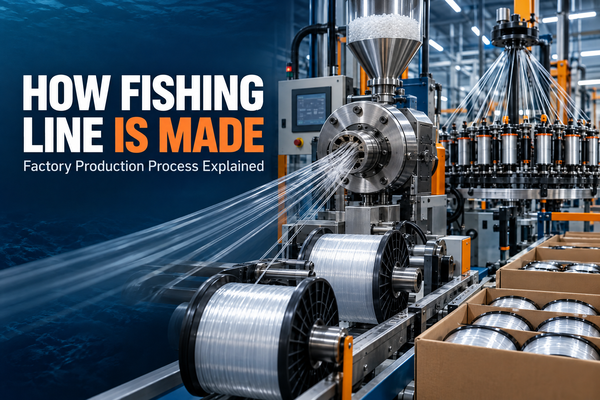
Fishing line might seem simple at first glance, but its manufacturing process requires precision engineering to balance key performance factors. From raw material selection to extrusion, weaving, and winding, every step in the production process influences how the fishing line performs. In this article, I’ll explain how fishing line is made, step by step, and why manufacturing details matter for product reliability.
Fishing line is made by extruding nylon monofilament or weaving strands of synthetic fibers into a braid. Key factors like resin preparation, tension control, cooling, stretching, and coating influence characteristics such as strength, diameter, flexibility, abrasion resistance, and handling performance.
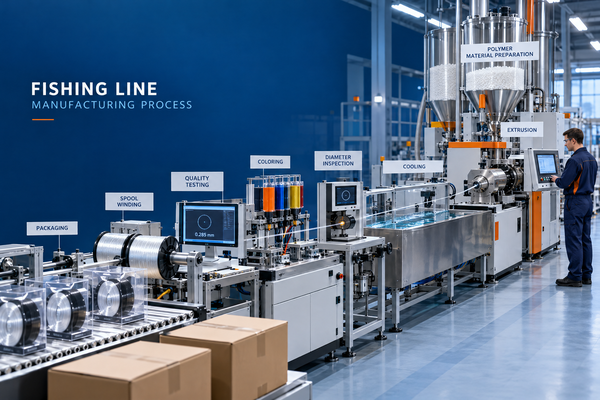
Quality fishing lines rely on carefully managed production parameters and frequent testing. Let’s break down the manufacturing process for monofilament and braided lines.
What is the process for making nylon monofilament?
Monofilament lines are made using a process of extrusion and stretching, turning raw resin into finished fishing line.
To make nylon monofilament, manufacturers prepare a nylon resin blend, extrude it into thin strands at controlled temperatures, cool it down in water, then stretch the line to refine its diameter, memory, and strength properties.
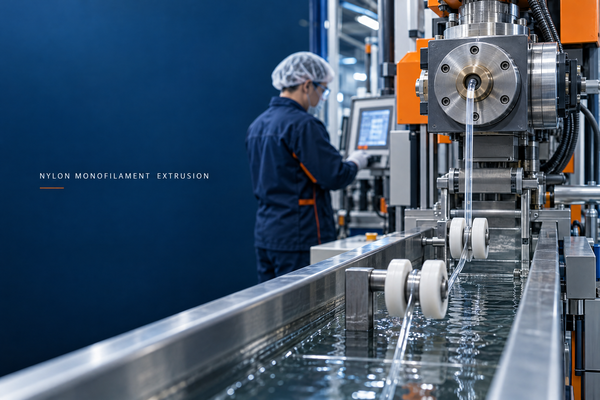
Breaking down the monofilament production steps
-
Resin Preparation:
Manufacturers combine specific blends of nylon resin with additives to tune properties such as strength, flexibility, and UV resistance. Variations in resin type can greatly affect the final product. -
Extrusion:
The resin is melted and extruded through a spinneret into continuous strands of molten nylon. The extrusion temperature must be tightly controlled; if the temperature is too high or too low, it can result in uneven diameter or degraded material strength. -
Cooling:
The molten filaments are immediately cooled in water baths or air conditioning chambers. Rapid cooling affects the tensile properties, while slower cooling can impact memory and flexibility. -
Stretching:
After cooling, the monofilament undergoes stretching to achieve proper diameter and performance attributes. Stretching increases the breaking strength while reducing elongation and undesirable memory effect. The stretching ratio—how much the line is elongated—is a critical variable. -
Quality Testing:
Manufacturers inspect for diameter consistency, strength, and surface smoothness before the line moves to winding. Quality checks here help catch defects early rather than at the final product stage.
Why are extrusion and stretching critical?
The extrusion and stretching process largely determines the line’s diameter, breaking strength, memory, and handling performance. Improperly controlled parameters can result in brittle lines, inconsistent spools, or high memory that hinders casting.
How is braided fishing line manufactured?
Braided fishing lines are constructed by weaving multiple strands of synthetic fibers—like PE (polyethylene)—into a unified structure. Unlike monofilament, braided lines rely on textile production techniques.
Braided fishing line is made by selecting fine fibers, twisting them into multi-stranded yarns, weaving the strands under controlled tension and density, then applying coatings to enhance abrasion resistance and handling.
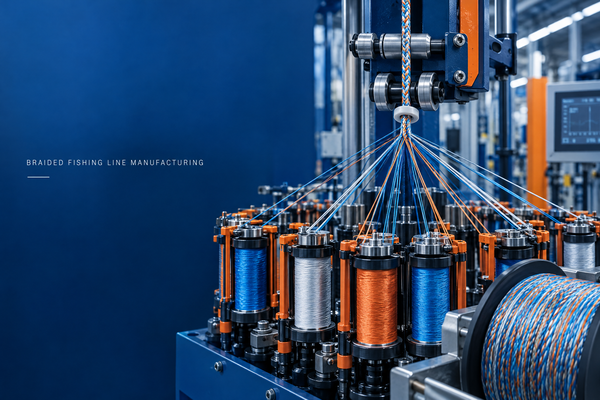
Breaking down the braided line production steps
-
Fiber Selection:
Manufacturers select synthetic fibers such as spectra or Dyneema with high tensile strength and flexibility. Fibers can vary in their abrasion resistance and diameter. -
Strand Preparation:
Fine strands are twisted into yarns with the desired strand count (e.g., 4-strand, 8-strand). Each additional strand can improve strength but has trade-offs with diameter and line noise. -
Weaving:
The yarns are braided into a single fishing line structure using controlled weaving machines. Variables include braid tightness, density, and tension. Tight weaving increases strength and durability but can affect smoothness and stiffness. -
Coating and Finishing:
Braided lines are often coated to improve roundness and abrasion resistance. Coatings can also reduce rod noise or make the line more water-resistant. -
Intermediate Testing:
Diameter control and tension consistency during intermediate stages help ensure finished properties like roundness.
Common challenges in braided line production
Maintaining tension during weaving is critical; uneven tension can produce flat or irregular braids, compromising handling and spooling. Additionally, high braid density can impair casting distance for certain applications.
Why does the winding process matter?
Winding might sound like a cosmetic step, but it is critical for maintaining fishing line quality.
Winding onto spools must use precise tension control to avoid flattening, overstretching, or tangling of the line. Poor winding can cause spool instability and uneven line lay during fishing.
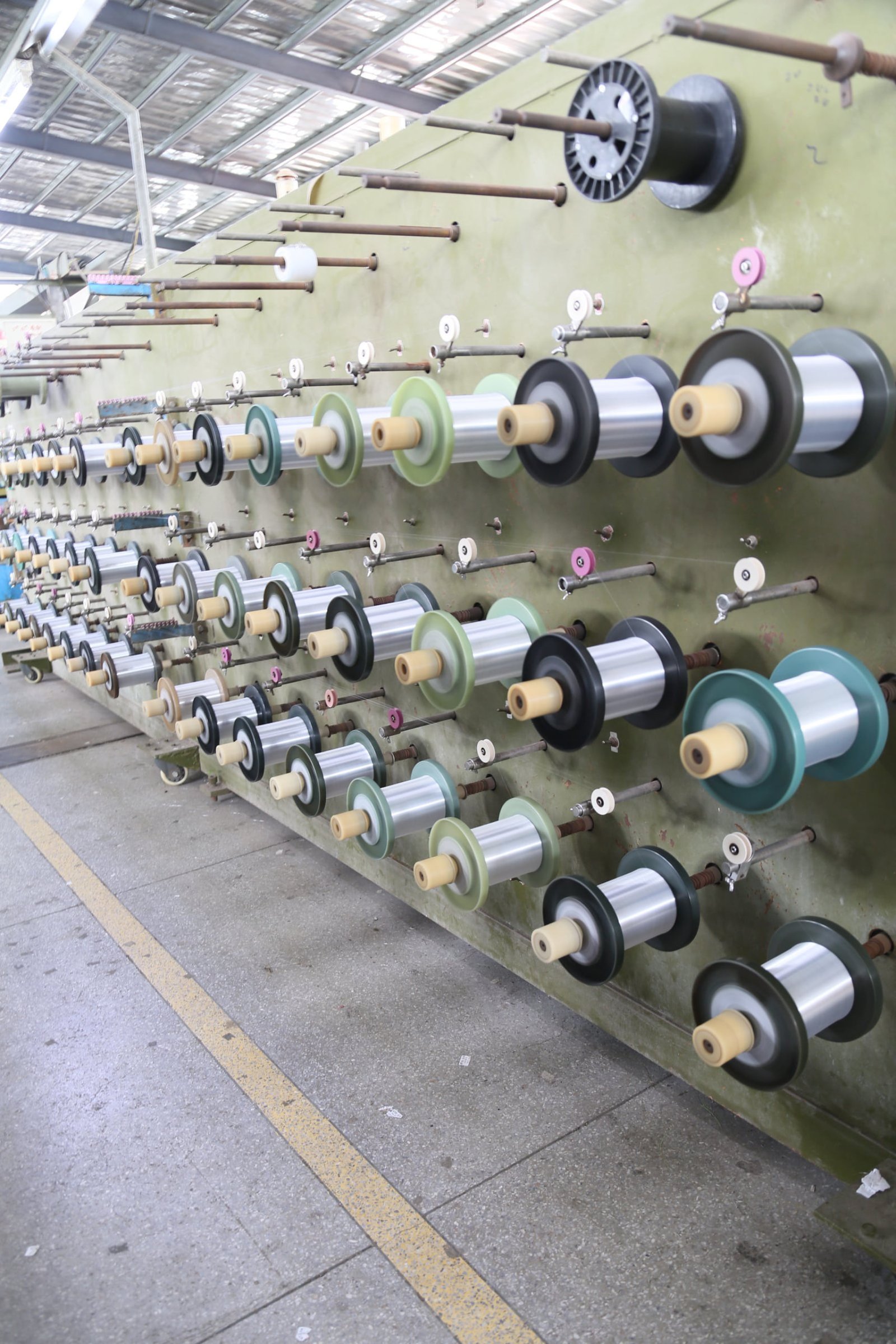
Key considerations during winding
-
Tension Control:
Too much tension can compress or flatten braided lines, reducing their roundness. Too little tension can lead to loose spooling and inconsistent lengths. -
Spool Configuration:
Spools must be designed to avoid trapped lines, tangles, or wasted material. Bulk packaging for distributors requires heavy-duty spooling setups compared to smaller retail packaging. -
Uniform Line Lay:
Evenly distributing the line on the spool prevents memory issues and tangles during use.
How is quality controlled during fishing line production?
Reliable manufacturers don’t wait for the final stage to detect production defects. Instead, they test and monitor intermediate steps, ensuring process parameters meet set tolerances.
Accurate quality control records—covering extrusion temperatures, fiber tension, braid uniformity, and stretching ratios—help manufacturers catch defects early and produce repeatable results in mass production.
Common quality control tests
| Test | Purpose |
|---|---|
| Diameter Measurement | Ensures consistent size and spool capacity |
| Breaking Strength | Verifies tensile performance meets specifications |
| Knot Strength | Evaluates performance at critical connection points |
| Abrasion Resistance | Simulates real-world wear against rough surfaces |
| Memory Testing | Measures how much the line retains curl or shape after stretching |
Manufacturers who log and analyze process data for every batch can ensure greater consistency across spools and product lines.
Frequently Asked Questions
What’s the difference between monofilament and braided fishing lines?
Monofilament line is a single strand of extruded nylon, while braided line is woven from multiple synthetic fibers. Monofilament is more stretchable and easier to manage, whereas braided line offers higher strength and sensitivity.
Why does fishing line diameter matter?
Diameter affects line capacity, casting performance, and visibility underwater. Thinner lines typically cast better and are less visible, but they may sacrifice abrasion resistance.
How does coating enhance braided lines?
Coatings improve abrasion resistance, reduce noise during casting, and help braided lines maintain their roundness. They can also make the line more water-resistant for saltwater applications.
Conclusion
Fishing line production is precision-driven, from the extrusion and stretching of monofilament to the weaving and coating of braided lines. Factors such as resin quality, extrusion temperature, braid tension, and winding consistency directly affect key properties like diameter, breaking strength, flexibility, memory, and abrasion resistance.
When sourcing fishing lines, verifying production processes and quality control records can help ensure a reliable, high-performing product. If you’re looking for tailored fishing line manufacturing solutions, we specialize in OEM production designed around your market needs. Contact us today to define your next fishing product with confidence!