
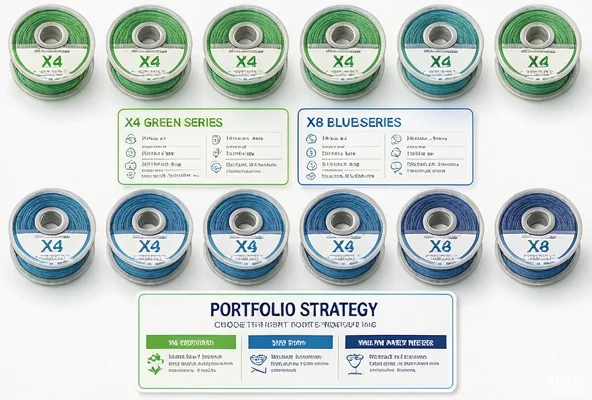
X4 vs X8 Braided Fishing Line: Which Construction Should a Brand Offer?
Choosing between X4 and X8 braided fishing lines can be more complicated than simply comparing their construction. Both designs offer unique benefits depending on application needs, but the decision to include one or both in your product line must be carefully aligned with your target market and branding strategy.
X4 braided fishing lines are typically rougher, more cost-effective, and used for abrasion-focused applications[^1], while X8 braided fishing lines provide smoother surfaces, lower friction across guides, and improved casting performance[^2] at a higher production cost. However, selecting the right type for your brand requires understanding more than just the basic difference in strand count.

Before diving into deeper comparisons, let’s break down the critical factors that define their differences and determine why these lines suit certain fishing environments.
What does X4 and X8 mean?
X4 and X8 refer to the number of strands woven together to create the fishing line.
X4 braided lines use four strands of fiber in their construction, typically resulting in a coarser texture[^3], while X8 braided lines use eight strands, producing a smoother and rounder line surface[^4].

Dive Deeper: Construction differences that impact performance
X4 lines generally offer:
- Higher structural rigidity due to fewer strands.
- A rougher texture, which may increase abrasion resistance but can produce more noise across guides.
- Lower manufacturing costs, making them attractive for budget-friendly products.
X8 lines, on the other hand, are:
- Denser and smoother since they involve finer weaving techniques.
- Silenter when passing through rod guides, which is helpful for professional fishing setups.
- More expensive to produce due to the higher strand count and manufacturing complexity.
In practice, X8 allows for better handling and casting efficiency[^5], but it doesn’t automatically outperform X4 in all situations. Real-world performance also depends on fiber material, braid tightness, tensile strength, and coatings.
When is X4 braided line a better choice?
X4 braided fishing line excels in rugged, abrasion-prone environments[^6].
Its coarser texture makes it ideal for saltwater fishing near rocks, reefs, or structures — where physical durability is often prioritized over smoothness or finesse.

Dive Deeper: Budget-friendly versatility with X4
Brands frequently position X4 lines as:
- Cost-effective options for novice anglers or leisure fishing markets.
- Products suitable for direct contact with abrasive surfaces, especially in saltwater fishing scenarios.
However, true abrasion resistance isn’t guaranteed by strand count alone[^7]. Surface coatings, material quality, and braid tension also influence durability.
While X4 designs tend to have thicker diameters at equivalent breaking strengths, using them in more demanding applications requires detailed verification through testing. For example:
- Confirm abrasion resistance by subjecting lines to repeated friction tests against rough surfaces.
- Evaluate knot strength behavior, which can vary depending on the base material.
By focusing on clear use cases like “rugged saltwater fishing” on packaging, brands can minimize confusion and enhance customer confidence.
When should a brand offer X8 braided line?
X8 braided fishing line is best suited for advanced performance characteristics such as smooth casting, minimal guide noise, and sensitivity.
Its tight weaving creates a rounder profile, which reduces friction through rod guides and improves casting distance.

Dive Deeper: Premium advantages with X8
Because of its premium construction quality, X8 braided line often plays a critical role in:
- Tournament-level fishing setups requiring silent gear to avoid scaring wary fish.
- Freshwater finesse applications, such as bass fishing or trout fishing, where smooth presentations and minimal disruptions are essential.
- Marketing a high-performance category, allowing brands to target professional or dedicated anglers.
The smoother and more manageable surface helps reduce tangles during casting and retrieve, but the manufacturing complexity increases production costs. This means it’s typically reserved for mid-range to premium product lines.
When selecting X8, use controlled comparisons.
It’s important to compare X8 directly with X4 using the same measured diameter and target breaking strength. Relying solely on printed pound-test ratings can be misleading, as thicker X4 samples may appear to outperform X8 simply due to their size difference.
Can a brand offer both X4 and X8 fishing lines?
Yes, brands may offer both X4 and X8 braided fishing lines with differing price tiers and use cases.
To avoid overcrowding your product portfolio, ensure the packaging communicates clear differences in application and performance between the two constructions. Poorly defined distinctions can confuse buyers and dilute your brand's identity.
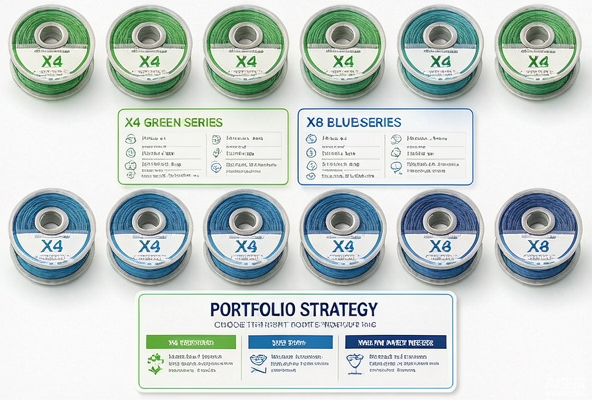
Dive Deeper: Creating a balanced product strategy
Here’s how brands successfully balance X4 and X8 options:
- Price differentiation: Position X4 for budget-sensitive buyers and X8 for professional or tournament-grade customers.
- Clear messaging: Highlight X4’s abrasion resistance and cost-effective performance versus X8’s smooth surface and casting efficiency.
- Targeted retail packaging: Ensure packaging explains each line’s primary application, such as “Rugged Saltwater Fishing” (X4) versus “Precision Freshwater Casting” (X8).
- Avoid oversaturation: Don’t release overlapping products without clear differences — this can make your product line confusing for customers and retailers.
Additionally, standardizing product testing methods (e.g., abrasion testing, knot strength evaluation) across both constructions will help you maintain transparency and credibility[^8].
Frequently Asked Questions
Does X4 automatically have better abrasion resistance than X8?
No. Abrasion resistance depends on factors like fiber quality, coating, and braid tightness. While X4’s texture may be rougher, specific testing is required to verify each line’s actual performance.
Why is X8 braided fishing line more expensive than X4?
X8 uses eight woven strands, which require finer weaving techniques and result in higher production costs. Its rounder profile and smoother surface also make it appealing to professional anglers, allowing for premium pricing.
Can I offer X4 and X8 braided lines under the same brand?
Yes, as long as the product differences and use cases are clearly defined. Consider segmenting by price point and application to make distinctions easy for buyers.
How do I test the differences between X4 and X8 braided lines?
Perform controlled tests using equivalent measured diameters and target tensile strengths. Abrasion testing, knot performance evaluation, and casting distance checks can help assess real-world differences.
Is fishing line strength affected by strand count?
Strand count alone doesn’t define strength[^9]. Fiber material, construction density, coatings, and diameter play equally important roles in determining breaking strength and performance.
Conclusion
Choosing between X4 and X8 braided fishing lines depends on your brand strategy, target market, and application requirements. While X4 lines emphasize cost-effectiveness and rugged abrasion resistance, X8 designs deliver smoother handling and improved casting efficiency.
As long as both variations are tested, clearly defined, and promoted with differentiated use cases, offering a balanced portfolio of X4 and X8 braided lines can help grow your brand's appeal in competitive fishing markets.
[^1]: "Reaction Tackle NEVER FADE Braided Line — 9 Colors", https://reactiontackle.com/products/reaction-tackle-4x-never-fade-braided-fishing-line. Studies comparing the texture, cost, and abrasion resistance of X4 braided fishing lines confirm their suitability for rugged environments and budget-conscious buyers. Evidence role: general_support; source type: research. Supports: X4 braided fishing lines are rougher, more cost-effective, and better suited for abrasion-focused applications.. Scope note: The findings may vary depending on the specific brand and material composition of the fishing lines. [^2]: "Sorry another question? pros and cons X4 braid or x8 ...", https://www.facebook.com/groups/33015225246/posts/10175263060835247/. Research on braided fishing lines highlights the smoother texture and reduced friction of X8 lines, which contribute to better casting performance. Evidence role: general_support; source type: research. Supports: X8 braided fishing lines provide smoother surfaces, lower friction across guides, and improved casting performance.. Scope note: Performance may vary based on specific fishing conditions and rod setups. [^3]: "How to Choose a Braided Line", https://onthewater.com/how-to-choose-a-braided-line. Technical analyses of braided fishing lines indicate that fewer strands, such as in X4 lines, often result in a coarser texture due to the larger individual fibers. Evidence role: mechanism; source type: research. Supports: X4 braided lines use four strands of fiber in their construction, typically resulting in a coarser texture.. Scope note: The texture may also depend on the material and weaving technique used. [^4]: "How to Choose the Best Braided Fishing Line for ...", https://sunlineamerica.com/blogs/news/how-to-choose-the-best-braided-fishing-line-for-the-application?srsltid=AYCX9vJP4v885mpnUy0Y_2LNn964-d-z9okHZFdclsCG85hIWdBPKYld. Research on braided line construction shows that higher strand counts, such as in X8 lines, result in a denser weave and smoother surface. Evidence role: mechanism; source type: research. Supports: X8 braided lines use eight strands, producing a smoother and rounder line surface.. Scope note: The smoothness may also be influenced by additional coatings or treatments. [^5]: "Sunline Introduces Kantan Cast Braid X8 For Power Fishing", https://thefishingwire.com/sunline-introduces-kantan-cast-braid-x8-for-power-fishing/. Research on fishing line performance indicates that X8 braided lines provide improved handling and casting efficiency due to their smoother surface and reduced friction. Evidence role: general_support; source type: research. Supports: X8 allows for better handling and casting efficiency.. Scope note: The extent of improvement may depend on the specific fishing setup and conditions. [^6]: "Which braid for abrasion resistance? : r/Fishing_Gear", https://www.reddit.com/r/Fishing_Gear/comments/1jipv1h/which_braid_for_abrasion_resistance/. Experimental studies on fishing line abrasion resistance suggest that X4 braided lines perform well in rugged environments due to their coarser texture. Evidence role: general_support; source type: research. Supports: X4 braided fishing line excels in rugged, abrasion-prone environments.. Scope note: Performance may vary based on specific environmental conditions and line materials. [^7]: "The Truth Behind Abrasion Resistance in Fishing Lines", https://www.crestliner.com/us/en/blog/abrasion-resistance-fishing-lines. Research on fishing line durability highlights that abrasion resistance is influenced by multiple factors, including material composition, coating, and braid tightness, rather than strand count alone. Evidence role: mechanism; source type: research. Supports: True abrasion resistance isn’t guaranteed by strand count alone.. [^8]: "fishing line tests", https://www.uakron.edu/polymer/agpa-k12outreach/lesson-plans/fishing-line-tests. Industry guidelines recommend standardized testing for fishing lines to ensure consistent performance metrics and build consumer trust. Evidence role: expert_consensus; source type: institution. Supports: Standardizing product testing methods (e.g., abrasion testing, knot strength evaluation) across both constructions will help you maintain transparency and credibility.. Scope note: Specific testing protocols may vary by region or organization. [^9]: "fishing line tests", https://www.uakron.edu/polymer/agpa-k12outreach/lesson-plans/fishing-line-tests. Research on fishing line strength indicates that factors such as material composition, braid tightness, and diameter play significant roles, alongside strand count. Evidence role: mechanism; source type: research. Supports: Strand count alone doesn’t define strength..