
How to Evaluate a Fishing Line Sample Before Mass Production
Approving fishing line samples is critical before moving to mass production. A sample may look and feel correct, but relying only on “first impressions” can result in product failures later[^1]. Careful evaluation based on measurable criteria is essential to ensure consistent, market-ready results[^2].
Evaluating a fishing line sample involves checking key performance factors like diameter, breaking strength, knot strength, and memory, followed by testing product usability in its intended application. After verification, results should be documented, and a reference sample should be retained to ensure consistency.

To fully understand how to evaluate a fishing line sample, we need to break down the process into functional stages. Let’s start by examining measurable performance characteristics.
Why is testing based on written objectives important?
Testing without clear benchmarks is like aiming without a target. Many buyers might approve fishing line samples based on vague impressions, such as the material's feel or a single breaking-strength test, but this is unreliable.
Evaluating samples using written objectives allows you to measure performance against both market benchmarks and product requirements. Vague impressions and short-term tests cannot guarantee consistent production quality.
Dive deeper
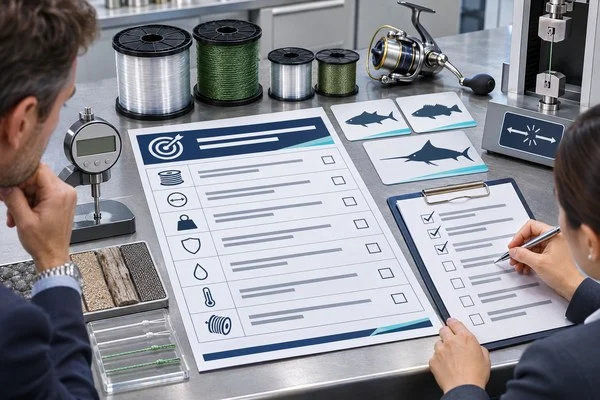
I always recommend defining measurable objectives before requesting samples from a supplier. These objectives should include:
- Market benchmark comparison[^3]: For example, if competing products have low memory but high abrasion resistance, these benchmarks should form part of the evaluation criteria.
- Application-specific traits: Saltwater offshore fishing requires very different properties[^4] (abrasion resistance, strength) than freshwater casting (flexibility, visibility).
- Physical requirements: Diameter, breaking strength, knot performance, memory, elongation rate, and length should all align with the customer’s expectations.
Defining performance objectives allows the evaluation team to separate perception from measurable reality while ensuring consistency between test results and product requirements. Without this clarity, decision-making becomes subjective, and risks of approving inconsistent samples increase.
How can physical performance parameters be tested?
Physical evaluation involves precise measurements, not simple visual inspection. Individual parameters like line diameter, breaking strength, knot strength, and elongation rate should be tested for accuracy across multiple samples.
Use a systematic method across multiple trials to measure diameter accuracy, tensile strength, knot strength, elongation, and spool length. These tests yield more reliable, repeatable results than informal handling.

Dive deeper
Testing physical parameters requires the right tools and methodology. Here’s how we approach this:
- Line diameter: Use a micrometer to measure diameter at multiple points, ensuring consistency. Deviations in diameter can affect breaking strength, spool density, and customer perception[^5].
- Straight-line breaking strength: Perform tensile strength tests on calibrated equipment using industry standards for fishing lines.
- Knot strength: Test critical connection points since knots are often the first place for failures under stress.
- Elongation rate: Measure the percentage stretch under load. Excessive elongation may improve flexibility but reduce sensitivity during fishing[^6].
- Actual spool length: Ensure lengths match specified packaging claims. Over- or under-length spools can quickly erode brand trust.
By conducting these tests systematically across multiple sample batches, discrepancies between production batches and approved specifications can be minimized.
Should usability tests simulate real-world fishing conditions?
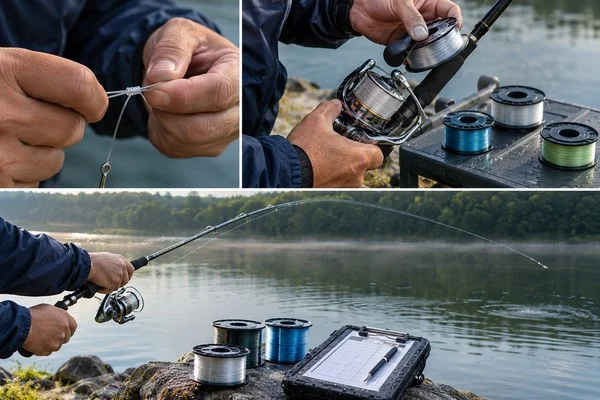
Yes, usability testing should reflect actual fishing scenarios to provide better insights into the product's performance. Depending on the target market, relevant tests might include casting, guide ring noise, memory retention, knot usability, abrasion resistance, or visibility underwater.
Usability tests simulate real-world fishing conditions[^7], ensuring the sample performs well in practical applications. This reduces post-launch complaints regarding casting quality, abrasion resistance, or other user concerns.
Dive deeper
Let’s break down key usability tests:
- Casting tests: Assess how smoothly the line casts, whether its flexibility aids or hinders casting distance, and whether it tangles during long casts.
- Guide ring noise[^8]: Check for abrasiveness-caused noise when the line moves against rod guides, especially in PE braided designs.
- Memory tests: Evaluate spool removal and extended storage for how much memory affects the line’s manageability.
- Abrasion resistance: Simulate contact with rocks and underwater structures for saltwater applications. Surface fraying can be a major cause of line failure.
- Visibility: Test the color selection in water conditions specific to the target market (e.g., clear freshwater vs murky coastal zones).
These tests reveal whether a fishing line’s technical properties align with its application requirements. It also prevents poor user experiences once the product reaches the market.
Why is evaluating assembly and packaging essential?
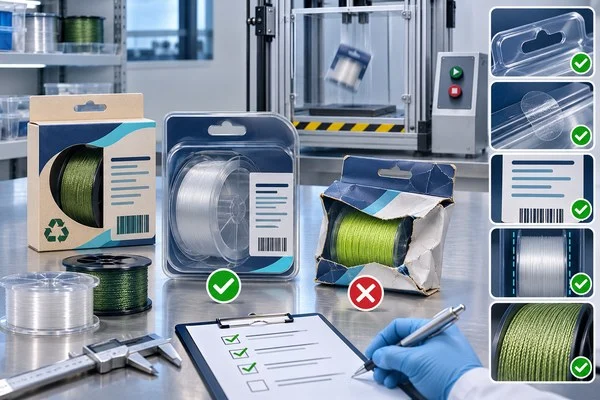
During sample development, assembly and packaging often rely on temporary materials, but this can hide potential mass-production issues. Incomplete evaluations of spool configuration, color, packaging dimensions, and branding can result in customer complaints about retail usability later on.
Evaluate the sample in its full assembly and packaging format[^9] to reveal potential incompatibilities in spool design, labeling accuracy, or packaging durability. Temporary development materials may conceal flaws that emerge in production scale.
Dive deeper
I’ve seen firsthand how temporary sample setups can lead to mismatches at later stages. To prevent this, I recommend scrutinizing:
- Winding quality[^10]: Ensure consistent tension and alignment during spool winding. Poor winding increases tangles and decreases perceived product quality.
- Spool design: Verify materials, size, and fit with common reel depths and packaging standards.
- Color consistency: Conduct uniformity checks across batches to avoid complaints about irregular colors.
- Labeling accuracy[^11]: Confirm all printed packaging information matches actual product specifications—including spool length, pound-test rating, and material type.
- Durability of packaging: Assess resistance to transportation impacts for e-commerce channels, shelf visibility for traditional retail, and bulk handling for distributorship channels.
Recording the results, signing off a reference sample, and sealing it for future alignment protects both parties from disputes about inconsistencies post-approval.
How should test results be documented?
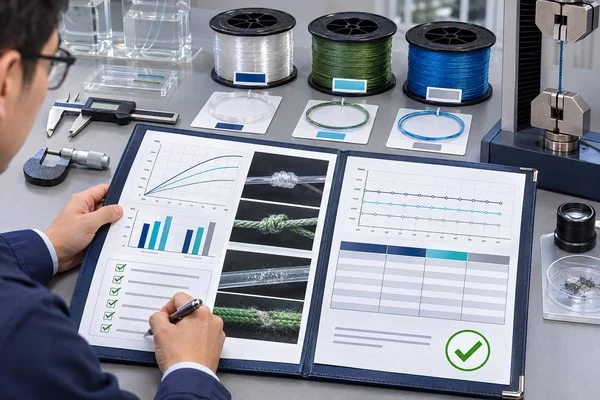
Test results should be carefully documented in a performance report, accompanied by signed-off specifications. A reference sample, sealed and maintained without modifications, provides a measurable production benchmark to prevent unapproved changes.
Document the performance results thoroughly and retain a reference sample to ensure production consistency. Any changes to materials, techniques, or packaging should require re-approval to prevent deviations.
Dive deeper
Finalizing sample evaluation requires both written and physical records. Here’s our process:
- Detailed test report: Include all measurable performance parameters (e.g., diameter variance reports, knot strength logs, elongation percentages).
- Specification sheet: Use signed-off specifications for each product feature—breaking strength, spool length, packaging design, etc.
- Sealed reference sample[^12]: Store an untouched sample with full documentation of its material properties, packaging, and appearance.
- Change approval process: Require new testing for any adjustments, down to minor shifts in color or packaging materials.
By retaining sealed reference samples alongside specifications, disputes over production outcomes can be minimized. Any post-approval changes should be carefully regulated to safeguard consistency.
Frequently Asked Questions
Why perform multiple tests instead of just one?
Single tests can miss variability between batches or individual spools. Multiple tests ensure consistent results across all samples.
Should packaging design matter during evaluation?
Yes. Packaging impacts user experience, shelf presentation, logistics, and brand perception. Evaluate it as part of the product.
What happens if production batches deviate from the sample?
Deviations can lead to performance issues, customer complaints, and product recalls. Reference samples and documented tests help maintain consistency.
Conclusion
Evaluating fishing line samples before mass production involves much more than a quick test or observation. From defining written objectives to physical measurements, usability testing, and packaging evaluation, the process ensures that products meet both technical specifications and customer expectations. By documenting the results and retaining a reference sample, manufacturers can guarantee consistency throughout production while protecting the brand’s reputation.
Looking to develop consistent, high-performance fishing lines? Contact Qiaohui Industrial Monofilament Co., Ltd., for customized OEM solutions built around measurable performance.
[^1]: "Remembering first impressions: Effects of intentionality and ...", https://pmc.ncbi.nlm.nih.gov/articles/PMC3267862/. Research has shown that insufficient product testing and reliance on subjective evaluations can lead to product failures and customer dissatisfaction, particularly in industries requiring high precision and reliability. Evidence role: general_support; source type: research. Supports: Relying solely on first impressions during product evaluation can lead to failures in later stages of production or use.. Scope note: The source may not specifically address fishing lines but provides general insights into the risks of inadequate product testing. [^2]: "The Importance of Quality Control in Manufacturing", https://www.ptc.com/en/blogs/plm/quality-control-in-manufacturing?srsltid=AYCX9vJytpAJJJ0RfTsCEC6GX4fNAwyTmA1Y39ps5gwdPzABKcPhaHqn. Educational resources on quality control emphasize the importance of measurable criteria in achieving consistent and reliable product outcomes. Evidence role: general_support; source type: education. Supports: Measurable criteria are critical for ensuring product consistency and market readiness in manufacturing processes.. Scope note: The source may discuss quality control broadly and not focus specifically on fishing line manufacturing. [^3]: "How do Consumers Understand Investment Quality?", https://www.sec.gov/files/performance-benchmarks-2022-01.pdf. Studies in product development highlight the role of market benchmarks in aligning product features with industry standards and consumer needs. Evidence role: general_support; source type: research. Supports: Market benchmark comparisons help ensure that products meet or exceed industry standards and customer expectations.. Scope note: The source may not specifically address fishing lines but provides general insights into the role of benchmarks in product evaluation. [^4]: "Freshwater Lines versus Saltwater Lines", https://scientificanglers.com/freshwater-fly-lines-versus-saltwater-fly-lines/. Encyclopedic entries on fishing techniques explain the distinct requirements for saltwater and freshwater fishing lines, including environmental factors like salinity and abrasion risks. Evidence role: general_support; source type: encyclopedia. Supports: Saltwater fishing lines require different properties, such as higher abrasion resistance and strength, compared to freshwater lines.. [^5]: "Comparing Measured Fluorocarbon Leader Breaking ...", https://ui.adsabs.harvard.edu/abs/arXiv:1202.5260. Research on fishing line mechanics shows that diameter consistency is crucial for maintaining breaking strength and spool performance. Evidence role: mechanism; source type: research. Supports: Variations in fishing line diameter can influence breaking strength, spool density, and customer satisfaction.. Scope note: The source may focus on technical aspects and not directly address customer perception. [^6]: "fishing line tests", https://www.uakron.edu/polymer/agpa-k12outreach/lesson-plans/fishing-line-tests. Studies on fishing line materials describe the trade-offs between elongation, flexibility, and sensitivity in practical applications. Evidence role: mechanism; source type: research. Supports: Excessive elongation in fishing lines can enhance flexibility but compromise sensitivity, affecting user experience.. [^7]: "Using clinical simulation to study how to improve quality and ...", https://pmc.ncbi.nlm.nih.gov/articles/PMC7056349/. Research in product testing highlights the importance of real-world simulations for evaluating performance and user satisfaction. Evidence role: general_support; source type: research. Supports: Simulating real-world conditions during usability tests provides more accurate insights into product performance.. Scope note: The source may not specifically address fishing lines but discusses the general benefits of real-world testing. [^8]: "Do Loud Noises Affect Fish? | Hook, Line and Science", https://ncseagrant.ncsu.edu/hooklinescience/do-loud-noises-affect-fish/. Research on fishing equipment performance indicates that guide ring noise can impact the user experience, particularly in braided fishing lines. Evidence role: mechanism; source type: research. Supports: Guide ring noise is an important factor in fishing line usability, as it can affect the fishing experience.. [^9]: "Evaluation of the functions of packaging and their relations ...", https://scholarworks.umt.edu/cgi/viewcontent.cgi?article=3278&context=etd. Educational materials on product development emphasize the importance of evaluating packaging and assembly to ensure compatibility and prevent issues during production. Evidence role: general_support; source type: education. Supports: Evaluating a product in its full assembly and packaging format can help identify potential issues before mass production.. [^10]: "Choosing the Right Fishing Line", https://www.wildlifedepartment.com/outdoorok/ooj/choosing-right-fishing-line. Research on fishing line manufacturing highlights the role of winding quality in preventing tangling and maintaining product integrity. Evidence role: mechanism; source type: research. Supports: Winding quality during spool preparation can influence tangling and customer perception of product quality.. [^11]: "The Top 3 Reasons for Label & Packaging Errors in Food ...", https://scm.ncsu.edu/scm-articles/article/the-top-3-reasons-for-label-packaging-errors-in-food-manufacturing. Educational resources on packaging emphasize the importance of accurate labeling for maintaining customer trust and regulatory compliance. Evidence role: general_support; source type: education. Supports: Labeling accuracy is essential to ensure that packaging information aligns with the actual product specifications.. [^12]: "Use of Sample Seals for Laboratory Samples - Revision 3", http://www.fsis.usda.gov/policy/fsis-directives/7355.1. Research in quality control practices highlights the role of sealed reference samples in maintaining consistency and resolving disputes. Evidence role: general_support; source type: research. Supports: Sealed reference samples are effective in preventing disputes over production inconsistencies..